Human-AI collaboration in HR: a guide for 2026

TL;DR:
- Most HR leaders mistakenly believe AI in recruitment will replace human judgment, but it is actually a collaborative tool. Human-AI integration involves humans overseeing AI insights to enhance decision quality while maintaining accountability and transparency. Complying with the EU AI Act by 2026 requires intentional workflows, leadership, and a culture that fosters responsible, trustworthy AI-powered hiring processes.
Most HR leaders we speak with assume AI in recruitment means automation replacing human judgement. It’s an understandable assumption, but it’s the wrong one. What is human-AI collaboration in HR is actually a much more exciting story: AI and humans working side by side, with transparency and accountability at every step, reshaping how you find, assess, and hire talent rather than sidelining the people doing it. With EU compliance deadlines approaching fast, understanding this distinction is no longer optional.
Table of Contents
- Understanding human-AI collaboration in HR
- Navigating the EU AI Act and its impact on HR practices
- Designing effective human-AI collaboration workflows in recruitment
- Building an AI-ready culture and leadership in HR
- Comparing human-AI collaboration models in recruitment
- Why human-AI collaboration is workforce design, not just technology
- Explore AI-driven recruitment with We Are Over The Moon
- Frequently asked questions
Key Takeaways
| Point | Details |
|---|---|
| Human-AI collaboration redefines HR workflows | Effective collaboration means AI supports humans with transparency and shared accountability, not replaces them. |
| Compliance with EU AI Act is critical | From August 2026, recruitment AI must include meaningful human oversight, transparency, and logging. |
| Human-in-the-loop workflows ensure trust | AI outputs must be reviewed and confirmed by humans with clear override mechanisms in place. |
| Leadership and culture shape success | Intentional leadership and an AI-ready culture build confidence and ensure ethical AI use in HR. |
| Not all AI collaboration models are equal | Human-in-the-loop is required for legal and practical reasons; fully autonomous AI is risky and non-compliant. |
Understanding human-AI collaboration in HR
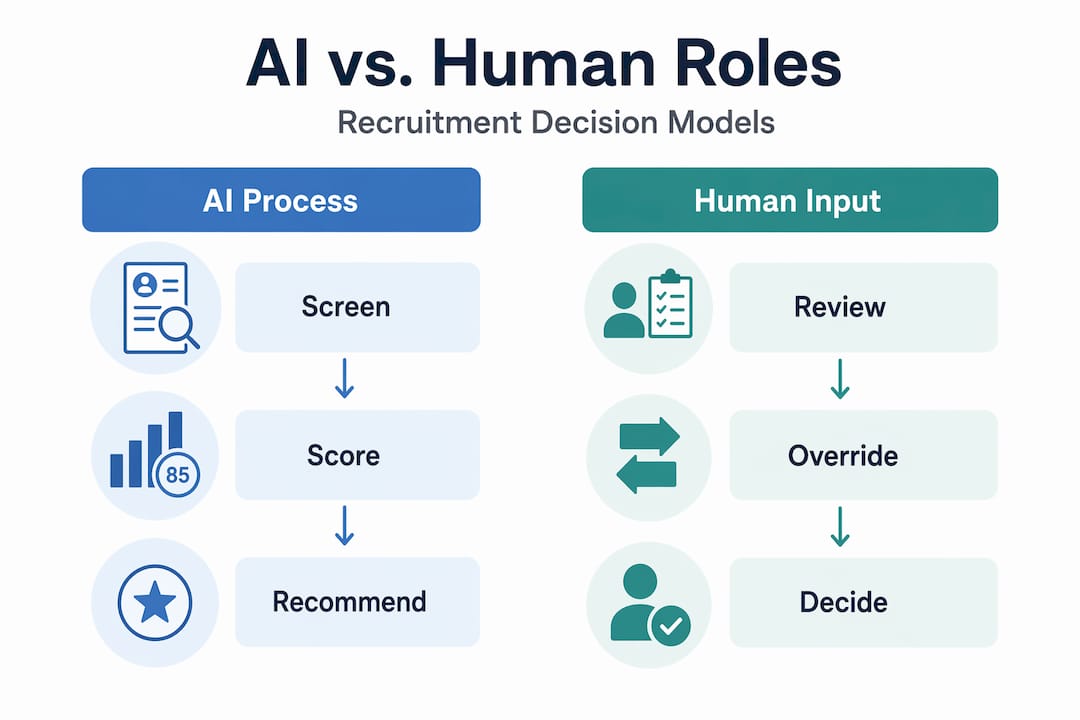
Human-AI collaboration in HR is not about handing your hiring process to an algorithm and walking away. It is about redesigning how work gets done so that AI handles the heavy analytical lifting while your team retains full authority over every decision that matters.
Think of it this way. AI can scan hundreds of applications, flag behavioural patterns in video interviews, and score candidates against cultural benchmarks in the time it takes a recruiter to make a coffee. But it is your recruiter who decides what to do with that information. AI augments rather than replaces the skills and judgement your HR team brings to every hire.
This matters because the value of human-AI teamwork in HR is not just efficiency. It is quality. When AI surfaces insights and humans apply context, empathy, and accountability, you get better hiring decisions than either could produce alone. That is the real benefit of AI collaboration.
Here is what this looks like in practice:
- AI screens and ranks applicants based on skills, competencies, and cultural fit signals, reducing the volume your team manually reviews
- Humans review and validate AI outputs, applying context AI cannot access, such as business priorities, team dynamics, or a candidate’s personal circumstances
- AI tracks patterns across your hiring funnel, flagging potential bias or inconsistency that human reviewers might miss
- Humans make final calls on every offer, rejection, or escalation, with full accountability for those decisions
- Collaborative workflows document every AI recommendation and every human override, creating a clear audit trail
Exploring the role of AI in recruitment in more depth will show you just how much the landscape has shifted in favour of this partnership model.
Navigating the EU AI Act and its impact on HR practices
Understanding human-AI collaboration is one thing. Knowing the regulatory environment shaping it in Europe is another. And right now, the EU AI Act is the most important piece of legislation on every HR leader’s radar.
From August 2026, recruitment AI is classified as high-risk, meaning HR teams across Europe face specific legal duties around how AI tools are deployed in hiring. This is genuinely good news for organisations already investing in thoughtful human-AI teamwork, because compliance and good practice point in the same direction.
Here are the key obligations you need to plan for now:
- Human oversight is mandatory. Every AI-assisted hiring decision must be reviewed by a qualified human before it takes effect. Fully automated rejections or offers are not permitted.
- Documentation and logging are required. You must keep records of how AI tools operate, what data they use, and how human reviewers interact with AI outputs.
- Transparency to candidates is compulsory. Applicants must be informed when AI is used in assessing them, and they must have a route to request human review.
- Regular risk assessments are expected. HR teams need to assess their AI tools for accuracy, bias, and fitness for purpose on an ongoing basis.
- Governance structures must be established. Someone in your organisation needs to own accountability for AI in recruitment, with clear escalation paths when things go wrong.
The AI in recruitment 2026 landscape is genuinely exciting for organisations that prepare well. Those who treat the EU AI Act as a compliance burden will miss the bigger opportunity: building hiring processes that candidates and regulators actually trust.
Designing effective human-AI collaboration workflows in recruitment
With the legal framework clear, the next question is how to actually build workflows that deliver on both compliance and quality. This is where many organisations stumble, not because they lack intent, but because they assume human oversight will happen organically. It won’t.
Effective human-AI collaboration requires explicit review queues and override mechanisms so that recruiters remain in control at every stage of the funnel. Without these structural features, “human oversight” is just a hope.
A practical workflow design should include:
- Dedicated review queues where AI outputs land before any candidate-facing action is taken
- Clear override logging so every time a recruiter accepts, modifies, or rejects an AI recommendation, that action is recorded with a timestamp and reason
- Stage-specific escalation protocols defining what happens when AI confidence is low, or when a recommendation falls outside normal parameters
- Bias monitoring checkpoints built into the workflow, not bolted on afterwards
- Candidate communication triggers that automatically notify applicants when AI has been used in their assessment
Human-in-the-loop design means AI proposes and humans decide, with every override documented. That documentation is not just good governance; it is your evidence of compliance.
Pro Tip: Run a workflow audit before August 2026. Map every point in your recruitment funnel where AI produces an output and ask: does a human see this before it affects a candidate? If not, that gap needs closing now.
The benefits of AI assessment are only fully realised when the human review layer is genuinely robust, not just a checkbox. Here is a quick reference for workflow design:
| Recruitment stage | AI role | Human role | Override required? |
|---|---|---|---|
| Application screening | Rank and flag candidates | Review ranked shortlist | Yes, before shortlist is finalised |
| Skills assessment | Score responses and flag patterns | Validate scores and context | Yes, before candidate advances |
| Video or AI interview | Analyse behaviour and language | Review analysis and decision | Yes, before invite or rejection |
| Final selection | Summarise candidate comparison | Make final offer decision | Always |
Pairing this table with a solid AI in recruitment candidate screening approach gives you a genuinely strong foundation.
Building an AI-ready culture and leadership in HR
Workflow design is necessary. But workflows only work when the people using them are confident, curious, and willing to challenge what AI tells them. That requires culture, and culture starts with leadership.

Successful human-AI collaboration hinges on intentional leadership that shapes accountability and trust every single day. This is not about your CHRO sending an email about AI strategy. It is about visible, ongoing commitment to training, dialogue, and honest conversation about where AI helps and where it does not.
What an AI-ready HR culture looks like in practice:
- Leaders model curiosity, not anxiety. When senior HR professionals openly question AI outputs and share what they learn, it gives the whole team permission to do the same.
- Training is role-specific, not generic. A recruiter needs to understand how the AI scoring model works for their specific pipeline, not just attend a one-hour webinar on “AI in the workplace.”
- Psychological safety is non-negotiable. Organisational culture and leadership behaviours must give people the confidence to challenge AI outputs and escalate concerns without fear of looking obstructionist.
- Cross-functional governance exists. HR, legal, and IT should share ownership of AI tools, with regular reviews that include frontline recruiters, not just senior managers.
“The question is not whether your team trusts AI. The question is whether your culture makes it safe for them to say when they don’t.”
Building this kind of culture also pays dividends in fairness. Teams that actively scrutinise AI outputs are far more likely to catch and address bias before it affects candidates. Understanding how AI reduces bias in recruitment becomes much more meaningful when your team is genuinely empowered to act on what they find.
Pro Tip: Create a monthly “AI review” slot in your HR team meetings. Spend fifteen minutes on one AI recommendation that was overridden, exploring why and what you learned. This builds literacy faster than any formal training programme.
Comparing human-AI collaboration models in recruitment
It helps to know that not all human-AI collaboration looks the same. There are three main interaction models, and choosing the right one has direct compliance implications under the EU AI Act.
| Model | How it works | Compliance status | Best for |
|---|---|---|---|
| Human-in-the-loop | AI proposes, human reviews and decides before action | Fully compliant | All high-risk recruitment decisions |
| Human-on-the-loop | AI acts, human monitors but does not review each decision | Insufficient for EU AI Act high-risk use | Low-risk administrative tasks only |
| Fully autonomous AI | AI decides and acts without human involvement | Non-compliant for recruitment | Not recommended in hiring |
Human-in-the-loop is required by the EU AI Act for high-risk recruitment AI. Human-on-the-loop simply does not meet the standard for roles where AI outputs affect candidates directly.
The implications are clear:
- If your current AI tools operate in human-on-the-loop mode for candidate screening, you need to redesign those workflows before August 2026
- Fully autonomous AI in hiring is not just legally risky; it produces worse outcomes because it removes the contextual judgement that improves decision quality
- Human-in-the-loop is not a constraint. It is the model that makes AI genuinely useful in recruitment
For a fuller picture of where this lands in practice, the pros and cons of AI hiring are worth exploring in detail.
Why human-AI collaboration is workforce design, not just technology
Here is our honest take, and it is one we feel strongly about. Most organisations approach AI in human resources as a technology procurement decision. They buy a tool, configure it, and assume the human oversight piece will sort itself out. It won’t, and that assumption is where things go wrong.
Human-AI collaboration is workforce design involving intentional leadership, not a software implementation. It means asking who is responsible for each decision, what authority they have, and how that authority is exercised and documented. These are organisational design questions, not technical ones.
The uncomfortable truth is that human oversight must be explicitly designed into your workflows. It cannot be assumed. When you assume it, you get the worst of both worlds: AI making consequential decisions without the accountability that human review provides, while HR teams believe they are in control because they technically have access to the system.
We are genuinely excited about what human-AI teamwork in HR can achieve when it is designed well. Better hires, fairer processes, faster pipelines, and teams that feel more capable, not less, because of the AI tools they work with. But that outcome requires treating this as a strategic redesign of how your HR function works, not just an upgrade to your recruitment software.
AI-driven sourcing can boost both recruitment quality and speed dramatically, but only when the human design around it is equally thoughtful.
Explore AI-driven recruitment with We Are Over The Moon
We are over the moon about what great human-AI collaboration can do for your hiring, and we have built our talent assessment platform specifically around this principle. Every AI-driven assessment we offer, from skills tests and cognitive challenges to cultural matching and video pitches, is designed with human oversight, transparency, and audit trails built in from the start.
Our AI candidate validation platform is built for European compliance, so you can move into 2026 with confidence rather than anxiety. We replace CV screening with real assessments that give recruiters richer insight and candidates a fairer shot. Want to see how it works for your team? Learn more about us and let’s explore how we can align your recruitment workflows with the future of HR together.
Frequently asked questions
What does human-AI collaboration mean in HR recruitment?
It means AI tools support human recruiters by providing analysis and recommendations, while humans retain final decision authority. AI supports human-led tasks with full transparency and accountability throughout.
What key responsibilities do HR leaders have under the EU AI Act for AI recruiting?
They must ensure meaningful human oversight, proper documentation, and transparency to candidates, while preventing fully automated hiring decisions. HR must plan oversight and logging to comply with the EU AI Act by August 2026.
How should AI and human interaction be designed in recruitment workflows?
Workflows should place AI outputs in dedicated review queues with clear override options, so recruiters confirm or reject AI recommendations before any candidate-facing decision is made. AI proposals should land in review queues allowing documented overrides at each decision point.
Why is cultural readiness important for successful AI collaboration in HR?
An AI-ready culture with clear leadership, training, and psychological safety helps HR teams trust AI tools, challenge outputs, and adapt workflows confidently. AI-ready culture aligns technology with human judgement through consistent training and visible leadership behaviours.
What are the risks of fully autonomous AI decisions in recruitment?
They risk legal non-compliance under the EU AI Act and produce worse hiring outcomes by removing the contextual human judgement that improves decision quality. Fully automated hiring decisions create legal exposure and poorer results compared to human-in-the-loop collaboration.