Asynchronous interviews: A smarter candidate assessment

TL;DR:
- Asynchronous interviews can significantly reduce application continuity, especially among women.
- They are best suited for high-volume early screening and international remote hiring.
- Combining async with live interviews ensures better cultural fit and candidate engagement.
Asynchronous interviews are often celebrated as a diversity win, a way to give every candidate a fair shot regardless of time zone or schedule. But the reality is more nuanced. Research shows that async interviews can reduce application continuation by over 50%, with the largest drop-off among women. That is a surprising finding, and it changes how we should think about rolling out this technology. This guide is here to help HR leaders in European tech companies understand exactly what asynchronous interviews are, when they work brilliantly, and how to implement them in a way that genuinely improves candidate assessment and cultural fit.
Table of Contents
- Understanding asynchronous interviews: The basics
- When and why to use asynchronous interviews in tech hiring
- How AI enhances asynchronous interviews
- Implementing asynchronous interviews: A 7-step process for European tech HR
- Why asynchronous interviews must be blended, not blindly applied
- Explore AI-driven candidate assessment for your team
- Frequently asked questions
Key Takeaways
| Point | Details |
|---|---|
| Flexible candidate screening | Asynchronous interviews enable flexible, scalable screening for high-volume tech roles. |
| AI boosts fairness | Artificial intelligence can reduce human bias and improve candidate success prediction. |
| Tailor for culture and role | Adapting questions and process to local cultures and job types is essential for effectiveness. |
| Blend methods for best fit | Combining asynchronous and live interviews helps capture both efficiency and cultural fit. |
Understanding asynchronous interviews: The basics
So, what exactly is an asynchronous interview? In simple terms, it is a process where candidates record their answers to a set of pre-defined questions, then submit those responses for hiring managers to review later. There is no live interaction. No scheduling gymnastics. Candidates complete the interview on their own schedule, and reviewers assess responses when it suits them.
This is quite different from a traditional in-person interview or even a live video call. In a live setting, both parties are present at the same time, and the conversation flows naturally. Asynchronous interviews remove that real-time element entirely, which brings both advantages and trade-offs we will explore throughout this article.
Platforms built for async hiring typically allow candidates to record video answers, submit written responses, or complete scenario-based tasks. In tech hiring specifically, this might include a short coding challenge, a product walkthrough, or a behavioural question recorded on camera. Understanding interview automation basics can help you see how these tools slot into a broader hiring workflow.
Here is a quick comparison to ground the concept:
| Format | Live interaction | Scheduling flexibility | Structured format | Best for |
|---|---|---|---|---|
| In-person interview | Yes | Low | Variable | Final stages, senior roles |
| Live video interview | Yes | Medium | Variable | Mid-stage screening |
| Asynchronous interview | No | High | Usually high | Early screening, high volume |
As structured async formats show, recorded video responses to scenario-based or technical questions are particularly effective for assessing soft skills at scale. That said, async interviews are not a universal solution. They shine in high-volume early screening but are less suited to senior or complex roles where human rapport matters enormously.
When async works well:
- Graduate and entry-level tech roles with high applicant volumes
- Remote or international positions across multiple European markets
- Roles where structured, comparable responses add real value
- Situations where speed and consistency are priorities
When and why to use asynchronous interviews in tech hiring
Now that we have defined the process, let us explore why and when asynchronous interviews deliver the most value, along with the risks HR leaders must weigh carefully.
The strongest use cases are high-volume early screening and international hiring. If you are recruiting across Germany, Spain, the Netherlands, and France simultaneously, async interviews remove the scheduling headache and create a consistent candidate experience. Every applicant answers the same questions under the same conditions, which makes comparison far more straightforward.
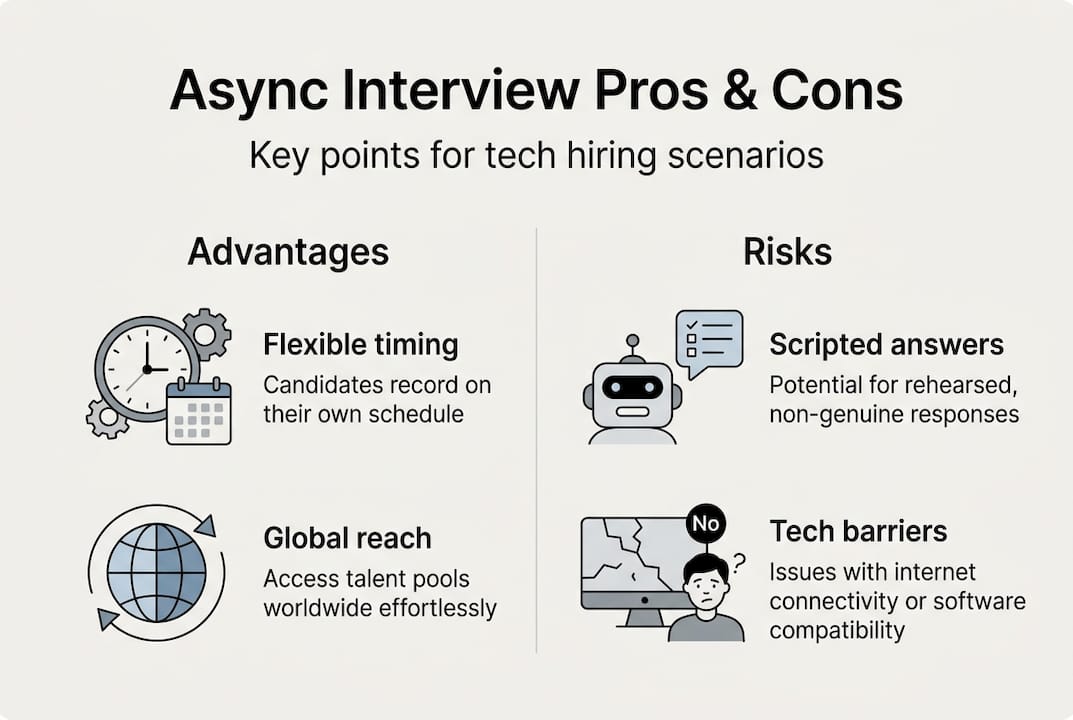
The evidence on soft skills assessment is genuinely exciting. Structured async interviews can improve soft skills assessment and reduce hiring time, though they risk higher drop-off rates, especially among women and less tech-savvy candidates. This is not a reason to avoid them. It is a reason to design them thoughtfully.
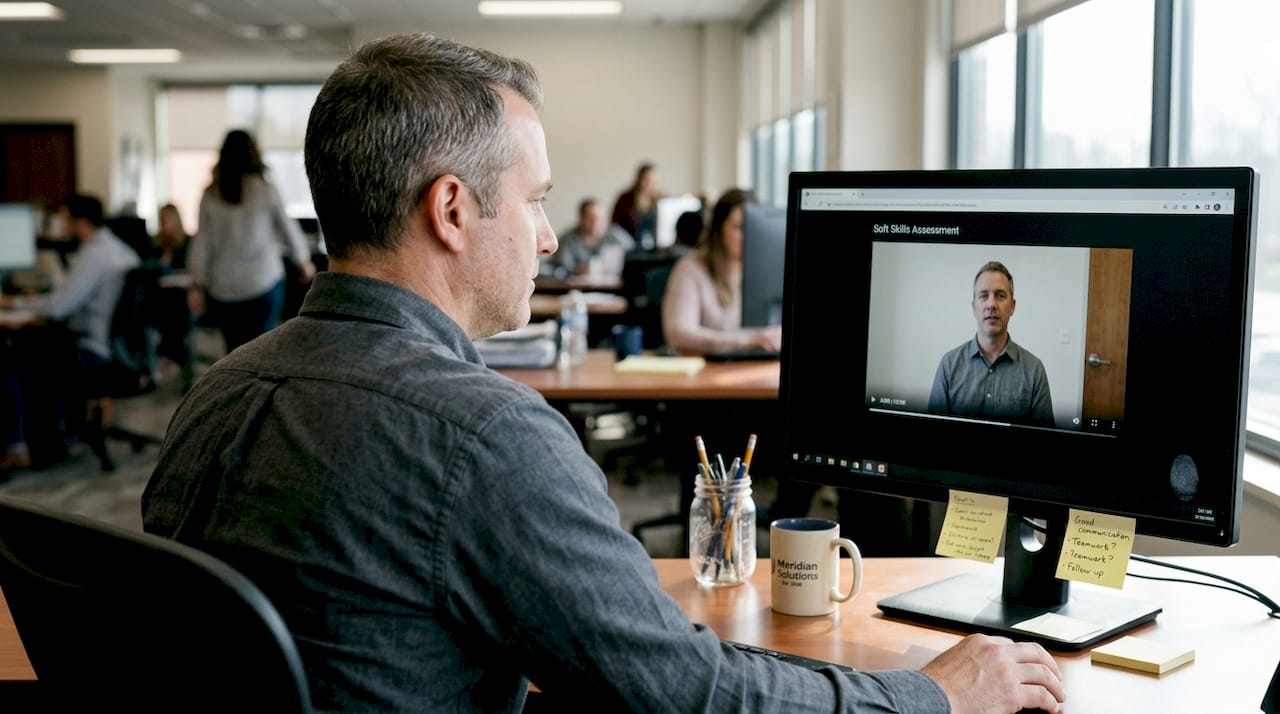
Cultural tailoring is also essential. What feels like a natural interview question in Spain may come across as overly personal in Germany, or too vague in the Netherlands. CERN recommends tailoring questions culturally rather than applying a one-size-fits-all approach across European markets. This is advice worth taking seriously.
Pro Tip: Before launching async interviews across multiple countries, run a small focus group with employees from each target market. Ask them to complete a test version of the interview and share honest feedback on tone, question clarity, and comfort level.
Here is a summary of the key trade-offs:
| Factor | Benefit | Risk |
|---|---|---|
| Scheduling flexibility | Wider talent pool | Higher drop-off rates |
| Structured questions | Fairer comparison | Scripted or rehearsed answers |
| AI scoring | Reduced human bias | Appearance bias risk |
| Remote access | International reach | Tech barriers for some candidates |
For practical examples of how this plays out, explore AI interview scenarios and the broader benefits of async interviews in modern tech hiring.
How AI enhances asynchronous interviews
With careful implementation, AI is transforming how asynchronous interviews are assessed. Let us dig into what this means in practice.
AI tools can analyse video and audio responses for a range of signals: language clarity, response structure, emotional tone, and even specific competency indicators tied to the role. This goes well beyond keyword matching. Modern platforms are trained to evaluate nuanced communication patterns that correlate with on-the-job performance.
The bias reduction evidence is striking. AI models score women and minority applicants higher than human assessors and predict employment outcomes more accurately. That is a meaningful finding for any HR team committed to equitable hiring. Human reviewers, even well-intentioned ones, carry unconscious biases that structured AI scoring can help to offset.
Here is a practical workflow for integrating AI into your async process:
- Define competency criteria before building any questions, so AI scoring is anchored to role-specific outcomes
- Select a platform that offers transparent scoring logic, not a black box
- Pilot with a small cohort and compare AI scores to human reviewer scores to check for alignment
- Review for appearance bias by auditing score distributions across demographic groups
- Iterate on questions based on which prompts generate the most predictive responses
“The goal of AI in hiring is not to replace human judgement but to make that judgement more consistent and less influenced by irrelevant factors.”
Pro Tip: Always audit your AI scoring data quarterly. Bias can creep in as models are updated or as your candidate pool shifts. Regular reviews keep your process honest.
That said, AI is not without limits. It can struggle with highly complex roles where interpersonal dynamics matter. It can also be gamed by candidates who learn to optimise for the system rather than demonstrate genuine capability. For guidance on reducing hiring time with AI and staying current with AI in recruitment 2026, both resources offer practical next steps.
Implementing asynchronous interviews: A 7-step process for European tech HR
Armed with the why and how, here is a step-by-step plan to implement and adapt asynchronous interviews in your HR process.
BlaBlaCar and JobTeaser both recommend a structured, phased approach with ongoing metric tracking and cultural adaptation for European hiring. We agree completely. Here is how to make it work:
- Define your success criteria for the role before writing a single question. What does great look like?
- Design structured questions that are scenario-based and culturally appropriate for your target markets
- Choose your platform with GDPR compliance, multilingual support, and transparent AI scoring as non-negotiables
- Pilot on a high-volume or entry-level role where the stakes are lower and iteration is easier
- Blend async with a live interview at a later stage to assess cultural fit and address any gaps
- Track key metrics including applicant drop-off rate, time to hire, and quality of hire post-onboarding
- Review and adapt every quarter, adjusting questions, scoring criteria, and cultural framing based on data
For cultural adaptation across Europe, keep this checklist in mind:
- Translate questions accurately, not just literally
- Test question tone with local employees before launch
- Adjust time limits to account for different communication styles
- Ensure your platform interface is accessible in local languages
- Check legal requirements for data storage and candidate consent in each country
For a deeper look at how AI is transforming assessment, the evidence base is growing fast and it is genuinely encouraging.
Why asynchronous interviews must be blended, not blindly applied
Here is something most guides on async interviews will not tell you: the efficiency gains can mask real human costs if you are not careful.
We are over the moon about what asynchronous interviews can achieve. But we have also seen what happens when organisations treat them as a complete replacement for human contact rather than one powerful tool among many. Personal interaction remains crucial for evaluating cultural fit and genuine engagement, and no scripted process or AI model fully replicates that.
The risks of over-reliance are real. Candidates can rehearse scripted answers. Tech barriers exclude people who are not digitally confident. And without any live touchpoint, you may hire someone who performs brilliantly on camera but struggles in your team’s actual working environment. That is a costly mistake.
The organisations getting this right are those who use async interviews to screen efficiently and then invest that saved time in richer, more meaningful live conversations later in the process. Async handles volume. Humans handle nuance. The blend is where the magic happens.
Ongoing review matters too. What works today may not work in six months as candidate expectations shift and AI tools evolve. Build in regular check-ins and stay curious about enhancing recruitment outcomes with a critical, open mind.
Explore AI-driven candidate assessment for your team
Ready to put these strategies into action? We are genuinely excited about what the right tools can do for your hiring process, and we would love to help you get there.
At WAOTM, we believe in replacing CV screening with real assessments. Our AI candidate validation platform brings together AI interviews, company challenges, cultural matching, cognitive tests, and video pitches in one place. It is designed specifically for teams who want smarter, fairer, faster hiring. Explore about our approach to see how we think about assessment, or dive straight into skills-based matching to find out how we help you identify the right people with confidence. We think you will be over the moon with the results.
Frequently asked questions
How does an asynchronous interview differ from a video interview?
Asynchronous interviews involve candidates recording answers to set questions on their own schedule, without a live interviewer. Traditional video interviews are live, with real-time interaction between both parties.
Are asynchronous interviews fairer for minority and female candidates?
AI scoring in async interviews rates women and minority candidates higher than human assessors and predicts employment success more accurately, though drop-off rates remain a concern that needs active management.
What are common challenges with asynchronous interviews?
Technical barriers, scripted answers, loss of live rapport, and high drop-off rates are the most common challenges, particularly for less tech-savvy candidates and women.
How should asynchronous interviews be adapted for different European countries?
HR teams should tailor questions and processes to local cultural expectations and legal norms. CERN’s guidance highlights that methods effective in Spain may not suit Germany, for example.
Is it possible to combine asynchronous and live interviews for better results?
Absolutely. BlaBlaCar and JobTeaser both recommend blending async screening with live interviews to capture cultural fit and address the limitations of a fully automated process.