AI Interviews: Transforming Candidate Assessment in HR

Selecting the right talent can feel unpredictable for HR managers working in fast-moving United Kingdom tech startups. Misunderstandings about artificial intelligence systems often create uncertainty and slow progress when considering new recruitment technologies. By clarifying common misconceptions about AI interviews and highlighting what these tools truly offer, this article helps you identify solutions that combine both rigorous candidate assessment and authentic cultural fit.
Table of Contents
- Defining AI Interviews And Common Misconceptions
- Types Of AI Interviews And Their Distinctions
- How AI Interviews Assess Skills And Culture
- Legal And Ethical Requirements For HR Use
- Risks, Bias, And Mitigating Compliance Issues
Key Takeaways
| Point | Details |
|---|---|
| AI Interviews Enhance Human Decision-Making | AI interviews utilise advanced algorithms to support, not replace, human recruiters by providing objective insights into candidate potential. |
| Types of AI Interviews Lead to Different Insights | Choosing between structured, semi-structured, and unstructured AI interviews helps HR professionals align assessment methods with specific role requirements. |
| Legal and Ethical Considerations are Crucial | Organisations must navigate legalities like data protection and anti-discrimination principles when implementing AI interview technologies. |
| Continuous Monitoring Mitigates Bias | Regular audits and diverse oversight are necessary to ensure AI recruitment systems remain fair and minimise algorithmic biases. |
Defining AI Interviews and Common Misconceptions
Artificial Intelligence (AI) interviews represent a sophisticated approach to candidate assessment that goes far beyond traditional screening methods. These innovative technological solutions leverage advanced algorithms to analyse candidate responses, communication styles, and potential cultural fit with unprecedented depth and objectivity.
At its core, an AI interview is not a robotic replacement for human interaction, but a nuanced tool designed to augment human decision-making processes. Despite widespread misconceptions, these systems are not about eliminating human judgment, but enhancing it through data-driven insights.
Common misconceptions about AI interviews often stem from fundamental misunderstandings about the technology’s capabilities and limitations. Here are the key myths that HR professionals frequently encounter:
- AI will completely replace human recruiters
- AI interviews evaluate candidates based on narrow, predefined criteria
- These technologies are inherently biased and unfair
- Only large corporations can effectively implement AI interview techniques
The reality is far more nuanced. Comprehensive research reveals that AI interviews are collaborative tools designed to support, not supplant, human recruitment expertise. They analyse complex patterns in candidate communication, providing recruiters with richer, more objective insights than traditional CV screenings.
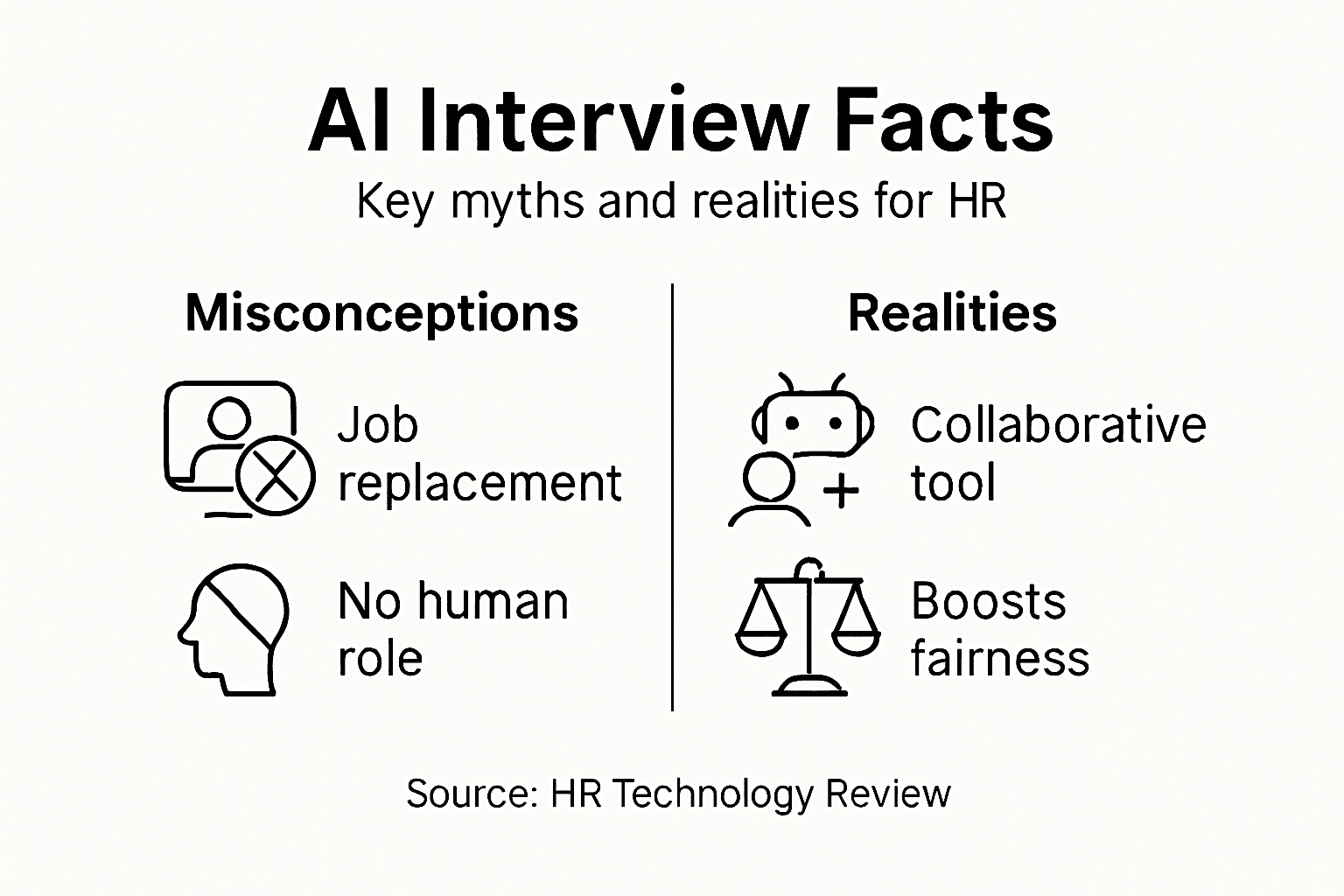
Understanding AI interviews requires recognising their core purpose: to create a more structured, fair, and comprehensive candidate evaluation process. These technologies can assess verbal and non-verbal communication cues, emotional intelligence, problem-solving approaches, and potential cultural alignment – aspects that traditional interviews might overlook.
Pro tip: When implementing AI interviews, always maintain a human-in-the-loop approach, using technological insights to complement, not replace, professional human judgment.
Types of AI Interviews and Their Distinctions
AI interviews have evolved into sophisticated assessment tools with multiple distinct approaches, each designed to capture unique insights into candidate potential. Comprehensive research in interview methodologies reveals a nuanced landscape of interview types that go beyond traditional recruitment techniques.
The primary categories of AI interviews can be broadly classified into three fundamental formats:
-
Structured AI Interviews
- Predefined questions with standardised evaluation criteria
- Minimal interviewer intervention
- High comparability between candidate assessments
-
Semi-Structured AI Interviews
- Blend of preset questions and adaptive follow-up inquiries
- Greater flexibility in candidate response exploration
- Balanced between systematic assessment and contextual understanding
-
Unstructured AI Interviews
- Conversational and exploratory approach
- Minimal predetermined question frameworks
- Maximum candidate expression and spontaneity
Detailed research on interview formats highlights that each approach offers unique advantages depending on organisational recruitment objectives. Structured interviews provide remarkable consistency and quantifiable metrics, while semi-structured formats allow deeper insights into candidate capabilities beyond rigid assessment parameters.
Technological advancements have transformed these interview types, enabling more sophisticated analysis of verbal and non-verbal communication cues. Modern AI systems can now interpret subtle linguistic nuances, emotional intelligence indicators, and complex communication patterns that traditional interview methods might overlook.
The table below compares key distinctions between structured, semi-structured, and unstructured AI interviews:
| Interview Type | Adaptability to Candidate Responses | Depth of Candidate Insight | Ideal Use Case |
|---|---|---|---|
| Structured | Low; highly standardised | Quantifiable, consistent | High-volume, technical roles |
| Semi-Structured | Medium; flexible follow-up allowed | Balanced, nuanced understanding | Specialist positions, creative roles |
| Unstructured | High; conversational and dynamic | Personal, in-depth exploration | Leadership or culture-focused search |
Pro tip: Select your AI interview type based on specific role requirements, ensuring the assessment methodology aligns precisely with the competencies you’re seeking to evaluate.
How AI Interviews Assess Skills and Culture
Modern AI interview technologies have revolutionised candidate assessment by developing sophisticated mechanisms that analyse both technical competencies and cultural alignment. Advanced interviewing systems now employ cutting-edge techniques like natural language processing and virtual simulations to evaluate candidates with unprecedented depth and precision.
The assessment process encompasses multiple critical dimensions of candidate potential:
-
Technical Skill Evaluation
- Coding ability assessments
- Problem-solving scenario analysis
- Technical knowledge verification
- Performance benchmark comparisons
-
Behavioural and Cultural Assessment
- Communication style analysis
- Emotional intelligence measurement
- Adaptability and collaboration indicators
- Alignment with organisational values
Nuanced soft skills evaluation represents a significant breakthrough in AI-driven recruitment. These technologies can now interpret subtle communication patterns, emotional responsiveness, and interpersonal dynamics that traditional interview methods frequently overlook.

The core strength of AI interviews lies in their ability to provide objective, consistent, and comprehensive candidate assessments. By analysing vast datasets and interaction patterns, these systems generate insights that go beyond surface-level impressions, offering organisations a more holistic understanding of potential team members.
Below is a summary of how AI interviews provide value across candidate skill and culture evaluation dimensions:
| Assessment Dimension | AI Analysis Technique | Example Outcome |
|---|---|---|
| Technical Skills | Automated scenario scoring | Identifies advanced coding capability |
| Communication Styles | Natural language analysis | Detects clarity and persuasion levels |
| Emotional Intelligence | Sentiment and tone mapping | Reveals adaptability under pressure |
| Cultural Fit | Value alignment algorithms | Matches with organisational ethos |
Pro tip: Design your AI interview parameters to balance quantitative skill assessment with qualitative cultural fit indicators, ensuring a multidimensional evaluation approach.
Legal and Ethical Requirements for HR Use
AI-driven recruitment technologies introduce complex legal and ethical considerations that organisations must carefully navigate. HR management’s ethical responsibilities extend far beyond traditional compliance, demanding proactive approaches to maintaining fairness, transparency, and individual privacy.
Key legal and ethical requirements encompass several critical domains:
-
Data Protection and Privacy
- Compliance with GDPR regulations
- Explicit candidate consent for data processing
- Secure storage of personal information
- Clear data retention and deletion policies
-
Anti-Discrimination Principles
- Preventing algorithmic bias
- Ensuring equal opportunity assessment
- Transparent decision-making criteria
- Regular bias auditing of AI systems
Comprehensive legal challenges in AI-driven recruitment demand rigorous governance frameworks. These systems must balance technological innovation with fundamental human rights, ensuring that automated processes do not compromise individual dignity or perpetuate systemic inequalities.
Organisations implementing AI interview technologies must develop robust internal policies that prioritise transparency, accountability, and continuous ethical monitoring. This involves creating clear mechanisms for candidates to understand, challenge, and appeal automated assessment decisions.
Pro tip: Develop a comprehensive AI ethics committee that regularly reviews and updates your recruitment algorithms to ensure ongoing legal compliance and fairness.
Risks, Bias, and Mitigating Compliance Issues
AI recruitment technologies introduce complex challenges that demand meticulous risk management and proactive bias mitigation strategies. Bias detection in AI-driven interviews represents a critical frontier in ensuring fair and equitable candidate assessment.
The primary risks in AI recruitment technologies encompass multiple domains:
-
Algorithmic Discrimination Risks
- Unintended demographic filtering
- Language and accent bias
- Facial recognition inaccuracies
- Historical dataset prejudices
-
Data Integrity Vulnerabilities
- Incomplete training datasets
- Lack of representative samples
- Potential systematic exclusion
- Limited contextual understanding
Comprehensive legal compliance strategies require organisations to implement rigorous governance frameworks that systematically identify and neutralise potential biases. This involves creating multi-layered assessment processes that cross-validate AI-generated insights with human oversight.
Successful bias mitigation demands continuous monitoring, regular algorithmic audits, and a commitment to transparency. Organisations must develop sophisticated mechanisms that not only detect potential discriminatory patterns but also create adaptive systems capable of learning and improving their fairness protocols.
Pro tip: Establish a diverse ethics review board that includes representatives from different demographic backgrounds to regularly assess and recalibrate your AI recruitment algorithms.
Revolutionise Your Hiring with AI Interviews Today
The article highlights the challenges of traditional recruitment such as biased CV screening and superficial candidate assessments. It emphasises the need for structured, fair, and data-driven AI interviews that evaluate not only technical skills but also cultural fit and emotional intelligence. If you want to overcome the pitfalls of inconsistent human judgement and harness comprehensive, objective candidate insights you need a solution that combines AI precision with human expertise.
Replace CV screening with real assessments using WAOTM’s innovative platform. We offer AI interviews, company challenges, cultural matching, cognitive tests, and video pitches to bring depth and fairness to your recruitment process. Discover how to select candidates based on meaningful data and values, not just first impressions.
Take control of your talent acquisition with tools designed to save time, reduce bias, and enhance decision-making. Visit WAOTM now and experience the future of recruitment to build winning teams that truly align with your organisation’s culture and values.
Frequently Asked Questions
What are AI interviews in the recruitment process?
AI interviews utilise advanced algorithms to assess candidates by analysing their responses, communication styles, and cultural fit, enhancing the traditional recruitment process.
How do AI interviews differ from traditional interviews?
AI interviews can analyse verbal and non-verbal communication cues and assess emotional intelligence, providing deeper insights into candidates compared to traditional methods that often rely solely on resumes and face-to-face interactions.
Are AI interviews biased in their assessments?
While AI systems may inadvertently reflect biases present in training data, proactive measures such as regular audits and diverse testing can mitigate these risks, ensuring fairer assessments in recruitment.
What types of AI interviews are available, and which should I choose?
AI interviews are typically structured, semi-structured, or unstructured. The choice depends on the specific needs of the role—structured interviews for consistency, semi-structured for flexibility, and unstructured for a more conversational approach.