How to Improve Candidate Matching for Better Hires

Missed hires and costly mismatches still frustrate even Britain’s most experienced hiring teams. Without shared clarity on what a new recruit truly needs to deliver, you risk early misunderstandings derailing the whole recruitment process. Bringing together hiring managers, team leads, and key stakeholders at the outset ensures candidate requirements reflect actual team needs, not guesswork. This shifts candidate matching from trial and error to a cohesive, evidence-backed process that fuels stronger hiring outcomes.
Table of Contents
- Step 1: Define Candidate Requirements Collaboratively
- Step 2: Integrate Advanced Assessment Technologies
- Step 3: Implement Structured AI Interview Processes
- Step 4: Validate Matching Accuracy With Real Data
Quick Summary
| Key Point | Explanation |
|---|---|
| 1. Involve the team in defining requirements | Collaborating with all stakeholders ensures clarity on skills, experience, and cultural fit needed for new hires, leading to better hiring results. |
| 2. Prioritise must-haves over nice-to-haves | Sorting requirements into essential and desirable skills helps to avoid excluding strong candidates who may lack non-critical attributes. |
| 3. Integrate advanced assessment technologies | AI-driven tools can enhance candidate screening and assessment accuracy, ensuring a more efficient hiring process. |
| 4. Structure AI interviews for consistency | AI interviews should be standardised to avoid unconscious bias and ensure candidates are fairly evaluated across all areas. |
| 5. Validate matching accuracy with data | Continuously track performance metrics of hires to refine and improve the candidate matching process based on real-world outcomes. |
Step 1: Define candidate requirements collaboratively
You cannot build a truly effective candidate matching process alone. Getting your whole team involved from the start makes all the difference when defining what you actually need from new hires. This collaborative approach ensures everyone’s voice shapes the requirements, leading to better alignment and stronger hiring outcomes.
Start by bringing together the key stakeholders who will work with or manage the new hire. This typically includes the hiring manager, relevant team members, HR representatives, and department leaders. Each person brings valuable perspective on what skills, experience, and cultural fit matter most.
Hold a structured discussion where each participant outlines their expectations. Ask specific questions about daily responsibilities, key challenges the role addresses, and what success looks like within the first three months. Research shows that effective communication and shared understanding among all involved parties drives successful candidate profiling.
Document what emerges from these conversations:
- Technical and soft skills required for the role
- Experience levels and specific domain knowledge needed
- Team dynamics and personality traits that fit your culture
- Performance metrics and measurable success indicators
- Growth and development opportunities within the position
Look for areas where people disagree. These gaps often reveal misaligned expectations that, if left unaddressed, create problems later. Work through the disagreements respectfully and reach genuine consensus rather than settling for compromise.
Once the group agrees on core requirements, prioritise them. Not every skill matters equally. Separate your “must-haves” from “nice-to-haves.” This clarity prevents you from screening out excellent candidates who lack a preference rather than a genuine need.
Document your final collaborative requirements in writing. Create a clear, shared reference document that everyone can review and confirm. This written version prevents misunderstandings and gives you a baseline to measure candidate fit against later.
Collaborative requirement definition prevents costly hiring mistakes and ensures your entire team is genuinely invested in finding the right person.
This foundation makes everything that follows in candidate matching significantly more effective.
Pro tip: Include your top performers in the requirement-setting conversation—they understand what actually succeeds in the role and can identify overlooked skills that matter in practice.
Step 2: Integrate advanced assessment technologies
Your collaborative requirements are now defined, but manual screening cannot handle the volume of applications efficiently. Advanced assessment technologies can match candidates to your requirements with remarkable precision whilst reducing the time spent on initial reviews. The right tools transform how you identify top talent.

Start by identifying which assessment methods align with your role requirements. Consider what you need to evaluate, whether that’s technical skills, cognitive ability, cultural fit, or communication style. Different roles demand different assessment approaches, so avoid a one-size-fits-all mentality.
AI-powered resume analysis forms your first automated gate. These systems use transformer-based deep learning models to analyse resumes and job descriptions, comparing candidate profiles against your specifications with impressive accuracy. This technology outperforms traditional applicant tracking systems by aligning results with what actually matters for the role.
Beyond resume screening, explore these assessment options:
- AI interviews that assess communication, problem-solving, and role-specific knowledge
- Cognitive and aptitude tests that measure reasoning and learning ability
- Work samples or practical challenges that mirror actual job tasks
- Cultural fit assessments that evaluate alignment with your company values
- Personality and behavioural evaluations for team compatibility
Implement these technologies thoughtfully. AI candidate screening enhances recruitment through automated analysis whilst reducing bias when implemented carefully. However, monitor for algorithmic bias and ensure your assessments remain transparent and fair.
Integrate your chosen tools into a coherent process. Candidates should move through assessments sequentially, with each stage filtering for specific competencies. This staged approach respects candidates’ time whilst giving you deeper insight into top performers.
Advanced assessments work best when they measure real job requirements, not arbitrary characteristics that sound impressive but don’t predict success.
Start with one or two assessment types and expand based on results. Measure how well your assessments predict actual job performance, then adjust your toolkit accordingly.
Here’s how different advanced assessment technologies contribute to the hiring process:
| Technology Type | What It Evaluates | Main Advantage |
|---|---|---|
| AI-powered CV screening | Qualifications and skills | Fast comparison with role requirements |
| Cognitive testing | Problem-solving and reasoning | Reveals learning potential early |
| AI interviews | Communication and approach | Provides consistent qualitative analysis |
| Cultural fit assessment | Value alignment | Boosts retention and team harmony |
Pro tip: Use assessment data to validate your initial requirement definitions—if strong performers are scoring unexpectedly low on certain assessments, your requirements may need refining.
Step 3: Implement structured AI interview processes
Your assessments have narrowed the field to genuinely promising candidates. Now it’s time to go deeper through structured AI interviews that evaluate how they think, communicate, and approach problems. These interviews provide rich qualitative insight that assessments alone cannot capture.
Start by designing your interview structure before you begin any interviews. Define the specific competencies you want to assess, the questions you’ll ask, and how you’ll evaluate responses. This consistency ensures fair comparison across all candidates and removes unconscious bias from the conversation.
Choose your AI interview platform carefully. Look for systems that support dynamic question adaptation and real-time support for interviewers, maintaining natural rapport whilst systematically collecting detailed candidate information. The best platforms assist human decision-making rather than replacing it entirely.
Structure your interview process in these stages:
- Create standardised question sets based on your role requirements
- Establish clear evaluation criteria before interviews begin
- Conduct interviews using AI-mediated conversation tools
- Collect and analyse qualitative data systematically
- Compare candidates using consistent scoring rubrics
AI-mediated interview tools automate the interview creation and question generation process based on your research goals, allowing you to conduct multiple interviews simultaneously whilst maintaining consistency. This efficiency means you can assess more candidates thoroughly without extending your timeline.
Maintain human oversight throughout. AI should enhance your interviews, not eliminate human judgement. Review candidate responses yourself, note your observations, and form your own impressions. Use the AI system’s insights as a starting point for deeper consideration.
Structured AI interviews work best when they feel like genuine conversations, not interrogations. Candidates should leave feeling heard, even if they weren’t selected.
Build feedback loops into your process. After hiring, compare your interview assessments against actual job performance. This data shows which interview questions genuinely predict success and which ones don’t, allowing you to refine your approach continuously.
Pro tip: Record key phrases and responses that correlate with top performers, then use these as benchmarks when comparing future candidates—consistency in evaluation transforms interviews from subjective impressions into objective comparisons.
Step 4: Validate matching accuracy with real data
You’ve built a matching process, but how do you know it actually works? Validation with real data transforms assumptions into evidence. This step proves whether your candidate matching genuinely predicts job success or needs refinement.
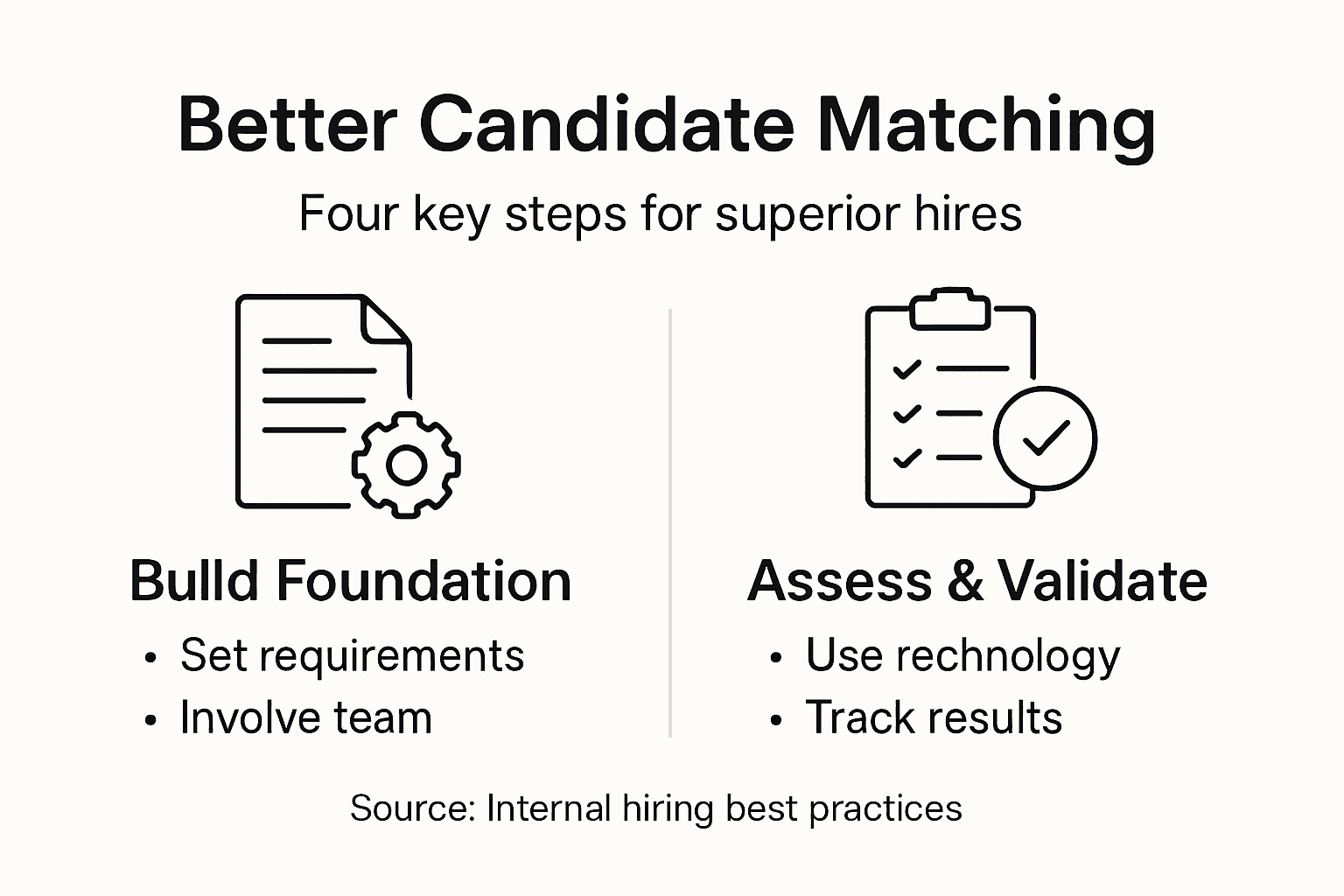
Start tracking key metrics from day one. Record which candidates your system identified as top matches and compare those predictions against actual job performance after three, six, and twelve months. This real-world comparison reveals whether your matching process truly identifies strong performers.
Measure these essential metrics:
- Time to productivity: How quickly did matched candidates reach full effectiveness?
- Quality of work: Does their performance match initial assessment predictions?
- Retention rates: Do matched candidates stay longer than poor matches?
- Manager satisfaction: Are hiring managers genuinely happy with selected candidates?
- Internal promotion rates: Which matched candidates advance within your organisation?
Collect feedback systematically from hiring managers and team leads. Ask specific questions about whether candidates met expectations, which skills proved most critical, and where assessments missed the mark. This qualitative data complements your quantitative metrics.
Use embedding-based evaluation and human assessment validation to test your matching accuracy. Compare your system’s candidate rankings against human expert judgement to identify alignment gaps. This dual approach catches cases where your algorithm excels but misses factors humans value.
Analyse patterns in your data. AI frameworks trained on large applicant datasets improve screening accuracy and validate matching reliability through measurable outcomes in precision, recall, and accuracy rates. Look for patterns where certain assessment questions strongly correlate with success, and where they don’t.
Adjust your process based on findings. If certain competencies you assessed proved unrelated to job success, remove them. If you missed critical skills, add assessments for those. This continuous refinement transforms your matching process from static to genuinely learning.
The best matching systems are never finished. They evolve as you gather more evidence about what actually drives success in your organisation.
Document your validation results and share them with your hiring team. Transparency about what works builds confidence and encourages continued engagement with your process.
This summary outlines key metrics for validating candidate matching accuracy:
| Metric | What It Measures | Why It Matters |
|---|---|---|
| Time to productivity | Speed of new hire effectiveness | Indicates onboarding and fit quality |
| Retention rates | How long hires stay | Signals job satisfaction and success |
| Manager satisfaction | Quality of the match | Highlights stakeholder buy-in |
| Promotion rates | Career progression of hires | Shows potential and long-term value |
Pro tip: Track your false positives and false negatives separately—high performers you almost rejected teach you as much as poor matches you almost selected, revealing hidden biases in your assessment criteria.
Unlock Superior Hiring with Advanced Candidate Matching Solutions
Finding the perfect hire starts with defining clear requirements and moving beyond traditional CV screening to assess real potential. If you’ve struggled with misaligned expectations or wish to validate candidate fit more accurately using AI interviews, cultural matching, and cognitive tests, you are not alone. The challenge is transforming collaborative insights into efficient, bias-reducing assessment processes that truly predict job success.
Discover how you can replace outdated screening methods with innovative assessments tailored to your needs at WAOTM. Our platform delivers AI-powered interviews, company challenges, and video pitches that bring your candidate matching to life. Start seeing results sooner by integrating real assessments that align perfectly with your hiring goals. Take the next step in smarter recruitment today by visiting https://www.weareoverthemoon.nl and experience how structured AI tools and cultural fit evaluations can revolutionise your hiring process.
Frequently Asked Questions
How can I define candidate requirements collaboratively with my team?
To define candidate requirements collaboratively, organise a meeting with key stakeholders such as hiring managers, team members, and HR representatives. Engage everyone in discussing what skills, experience, and cultural fit are essential, and document the outcomes for clarity.
What advanced assessment technologies should I consider for better candidate matching?
Consider implementing AI-powered resume analysis, cognitive tests, and AI interviews to enhance candidate matching. Choose assessment methods that align with your role requirements to ensure accuracy in identifying top talent.
How do I structure AI interviews to evaluate candidates effectively?
To structure AI interviews, create standardised question sets based on your defined competencies and establish clear evaluation criteria. This approach ensures fairness and consistency across candidate evaluations while delivering useful insights into their capabilities.
What metrics should I track to validate the accuracy of my candidate matching process?
Track key metrics such as time to productivity, retention rates, and manager satisfaction to validate the accuracy of your candidate matching. Regularly analyse these metrics to identify patterns and make necessary adjustments to improve your process.
How often should I review and adjust my candidate matching process?
Regularly review your candidate matching process at least every six months or after a significant hiring event. Gather feedback and performance data to refine the process continuously and ensure it aligns with your organisation’s evolving needs.
What actions can I take to prevent bias in my candidate assessment?
To prevent bias in candidate assessment, use structured evaluation criteria and implement a diverse hiring panel. Regularly review assessments to identify patterns of bias and adjust your requirements and screening processes accordingly.