Organisational Culture Fit: Shaping Effective Hiring

Every HR manager knows the pressure to build cohesive teams without sacrificing diversity or innovation. In fast-paced tech environments across Spain, United Kingdom, and Netherlands, organisational culture fit can either strengthen workplace harmony or become a source of unconscious bias. Understanding the dynamic nature of culture fit and the risks of misinterpretation empowers you to refine hiring assessments, making them fair, effective, and more inclusive.
Table of Contents
- Defining Organisational Culture Fit and Misconceptions
- Types of Culture Fit in Tech Workplaces
- How Culture Fit Assessments Work
- Challenges, Risks, and Bias in Culture Fit
- Best Practices for Fair and Effective Assessment
Key Takeaways
| Point | Details |
|---|---|
| Organisational Culture Fit Is Multifaceted | It includes shared values, norms, communication styles, and motivations, critical for workplace dynamics. |
| Assessments Should Combat Bias | Culture fit evaluations must be designed to prevent discrimination and promote diversity within organisations. |
| Understand Different Culture Archetypes | Recognising distinct cultural fits, such as innovation-driven or collaborative cultures, is vital for effective recruitment and team dynamics. |
| Continuous Improvement Is Essential | Regularly reviewing culture fit assessment methodologies ensures alignment with organisational goals and promotes fair hiring practices. |
Defining Organisational Culture Fit and Misconceptions
Organisational culture fit represents the critical alignment between an individual’s values, beliefs, and working style with the fundamental characteristics of their workplace environment. Academic research highlights that this concept goes far beyond simple recruitment criteria, serving as a complex mechanism that can profoundly shape workplace dynamics.
At its core, organisational culture fit encompasses several key dimensions:
- Shared core values and beliefs
- Behavioural norms and expectations
- Communication and interaction styles
- Psychological compatibility with workplace environment
- Alignment of personal and professional goals
However, the concept is fraught with potential misconceptions. Systematic reviews demonstrate that organisational culture is not a static construct but a dynamic system involving fundamental assumptions, norms, and shared beliefs created through external adaptation and internal integration.
A critical challenge with culture fit is its potential for unintended bias. While ostensibly about finding compatible team members, it can inadvertently become a mechanism for social exclusion. HR professionals must be vigilant about ensuring that culture fit assessments do not transform into discriminatory screening processes that marginalise diverse candidates.
Culture fit should enhance workplace harmony, not create artificial barriers to talent acquisition.
Potential Risks of Misinterpreted Culture Fit:
- Perpetuating homogeneous workforce demographics
- Limiting diversity and cognitive variety
- Creating echo chambers within organisations
- Reducing opportunities for innovative thinking
- Reinforcing unconscious biases
Pro tip: Develop culture fit assessment frameworks that explicitly measure candidate compatibility while maintaining strict neutrality towards protected characteristics and diverse backgrounds.
Types of Culture Fit in Tech Workplaces
Research into tech workplace dynamics reveals multiple distinct types of cultural fit that shape professional interactions and team dynamics in technological environments.
Tech workplaces typically exhibit several key culture fit archetypes:
- Innovation-Driven Culture: Prioritises creativity, experimentation, and rapid problem-solving
- Collaborative Culture: Emphasises teamwork, collective achievement, and knowledge sharing
- Results-Oriented Culture: Focuses on performance metrics, individual accountability, and outcome delivery
- Learning-Centric Culture: Values continuous skill development, adaptability, and intellectual curiosity
- Diversity and Inclusion Culture: Promotes equitable representation and psychological safety
Industry diversity reports demonstrate that these cultural types significantly impact recruitment, retention, and workplace satisfaction. Different organisations prioritise varying cultural dimensions, creating unique ecosystem environments that attract specific talent profiles.

Here is a comparison of common culture fit archetypes in tech workplaces and their typical business relevance:
| Culture Archetype | Workplace Emphasis | Typical Business Impact |
|---|---|---|
| Innovation-Driven | Creativity and experimentation | Rapid product development |
| Collaborative | Teamwork and knowledge sharing | Enhanced problem-solving |
| Results-Oriented | Accountability and outcomes | Improved project delivery |
| Learning-Centric | Continuous skill development | Higher adaptability |
| Diversity and Inclusion | Equitable representation | Broader market perspectives |
Understanding these cultural archetypes becomes crucial for both employers and potential employees. Tech professionals must recognise that culture fit extends beyond superficial compatibility, involving deep alignment with organisational values, communication styles, and professional expectations.
Culture fit is not about conformity, but about finding genuine synergy between individual potential and organisational vision.
Challenges in Culture Fit Assessment:
- Potential for unconscious bias
- Difficulty measuring intangible cultural elements
- Risk of excluding diverse perspectives
- Complexity of quantifying cultural alignment
- Balancing individual uniqueness with team cohesion
Pro tip: Develop multi-dimensional assessment frameworks that evaluate culture fit holistically, considering both soft skills and measurable professional competencies.
How Culture Fit Assessments Work
Culture fit assessments represent a sophisticated approach to evaluating candidate compatibility beyond traditional recruitment methods, grounded in rigorous psychological and organisational behavioural theories.
These assessments typically involve multiple sophisticated evaluation techniques:
- Situational Judgement Tests: Presenting candidates with realistic workplace scenarios
- Personality Questionnaires: Measuring individual traits against organisational values
- Behavioural Interviews: Exploring candidate’s past experiences and decision-making patterns
- Values Alignment Surveys: Quantifying congruence with company core principles
- Interactive Assessment Challenges: Simulating real-world work environments
Comprehensive evaluation methodologies focus on collecting objective data about cultural compatibility, aiming to improve hiring outcomes, reduce workforce turnover, and enhance overall employee engagement. The process goes beyond superficial matching, delving into nuanced understanding of candidate potential.
The core objective of culture fit assessments is creating a holistic view of candidate compatibility. This involves examining not just technical skills, but also psychological attributes, communication styles, and intrinsic motivational patterns that contribute to successful workplace integration.
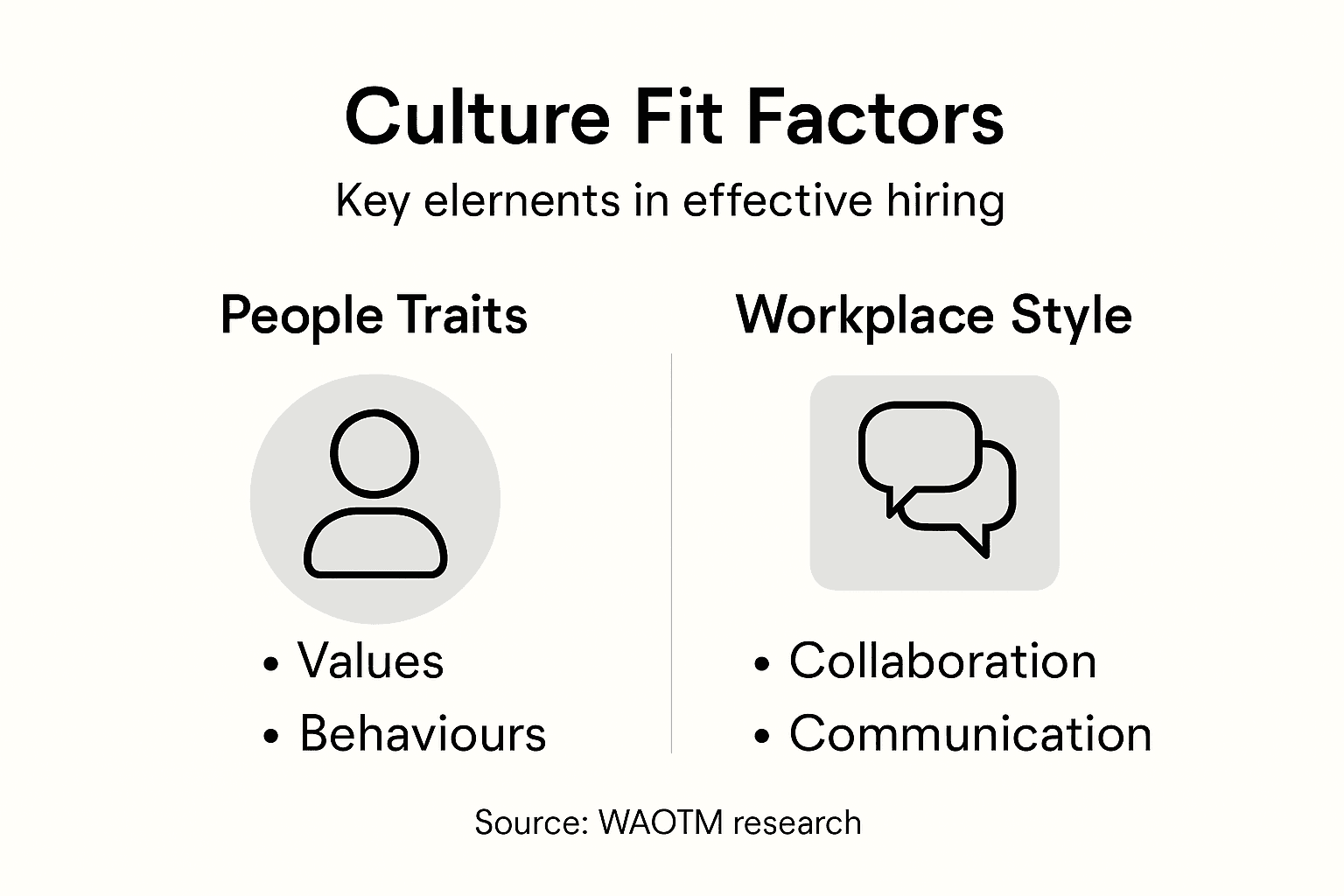
The table below highlights key differences between traditional hiring and culture fit assessments:
| Aspect | Traditional Hiring | Culture Fit Assessment |
|---|---|---|
| Focus | Technical skills, experience | Values, behaviours, motivation |
| Evaluation Method | CV review, basic interviews | Multi-dimensional, situational |
| Diversity Consideration | Often limited | Promotes or hinders diversity |
| Outcome | Short-term role fulfilment | Long-term workplace integration |
Culture fit assessment is an art of understanding human potential beyond conventional metrics.
Key Measurement Dimensions:
- Alignment with organisational values
- Adaptability to workplace dynamics
- Potential for collaborative engagement
- Intrinsic motivational drivers
- Psychological compatibility with team environment
Pro tip: Design multi-dimensional assessment frameworks that balance objective measurement with human intuition, ensuring a comprehensive evaluation of candidate potential.
Challenges, Risks, and Bias in Culture Fit
Research on cultural assessment biases reveals profound challenges in maintaining fairness and objectivity during hiring processes. The seemingly straightforward concept of culture fit can become a complex minefield of potential discriminatory practices that inadvertently perpetuate systemic inequalities.
Multiple types of inherent biases emerge during culture fit assessments:
- Affinity Bias: Unconsciously favouring candidates similar to existing team members
- Confirmation Bias: Seeking information that validates pre-existing beliefs about candidates
- Cultural Normativity Bias: Privileging dominant cultural perspectives
- Western-Centric Bias: Evaluating candidates against predominantly Western organisational norms
- Demographic Homogeneity Bias: Unconsciously selecting candidates who represent existing workforce demographics
Organisational research demonstrates that these biases pose significant risks to workplace innovation and diversity. By creating echo chambers of similar thinking and backgrounds, organisations inadvertently limit their potential for creative problem-solving and comprehensive perspectives.
Technology itself is not neutral in this landscape. Artificial intelligence and large language models used in assessment processes can perpetuate and even amplify existing biases, creating sophisticated yet potentially discriminatory screening mechanisms that appear objective but fundamentally reinforce systemic inequalities.
Culture fit should expand perspectives, not restrict them.
Potential Negative Consequences of Biased Assessments:
- Reduced workplace diversity
- Limited innovation potential
- Decreased employee engagement
- Higher turnover among marginalised groups
- Perpetuation of systemic inequalities
Pro tip: Implement blind assessment techniques and diverse evaluation panels to mitigate unconscious biases in culture fit evaluations.
Best Practices for Fair and Effective Assessment
Cultural fit assessment strategies require a sophisticated, nuanced approach that balances organisational needs with genuine inclusivity and fairness. The goal is creating an evaluation framework that identifies genuine compatibility without compromising diversity or individual potential.
Key components of effective culture fit assessment include:
- Transparent Value Definition: Clearly articulating organisational core values
- Structured Evaluation Frameworks: Using validated, objective measurement tools
- Behavioural Evidence Gathering: Focusing on observable actions rather than subjective impressions
- Diverse Assessment Panels: Including representatives from multiple backgrounds
- Continuous Learning Mechanisms: Regularly reviewing and refining assessment processes
Evidence-based organisational research emphasises the importance of linking cultural assessments directly to positive outcomes such as employee engagement, retention, and productivity. This requires moving beyond superficial matching towards understanding deeper psychological and professional compatibility.
Successful implementation demands a holistic approach that recognises culture fit as a dynamic, evolving concept. HR professionals must develop sophisticated assessment techniques that capture nuanced interpersonal dynamics while maintaining strict commitment to fairness and individual dignity.
Fair assessment is about understanding potential, not enforcing conformity.
Critical Assessment Elements:
- Objective measurement criteria
- Bias mitigation strategies
- Inclusive evaluation approaches
- Transparent communication protocols
- Continuous improvement mechanisms
Pro tip: Develop standardised assessment rubrics that explicitly score candidates on observable behaviours and competencies, not perceived cultural similarity.
Unlock Genuine Organisational Culture Fit with Smart Assessments
The challenge of aligning candidates with your organisation’s true culture is complex. Many hiring processes falter by relying on outdated CV screening that overlooks critical aspects like values alignment, behavioural norms, and psychological compatibility outlined in the article. These pain points can lead to unconscious bias, reduced diversity, and missed opportunities for innovation.
At WAOTM, we replace traditional recruitment methods with real, multi-dimensional assessments such as AI interviews, company challenges, cognitive tests, and cultural matching designed specifically to tackle these exact challenges. Our approach ensures you hire talent that not only fits your organisation’s culture but also brings authentic diversity and drives long-term engagement.
Experience how our innovative tools transform your hiring and genuinely shape effective teams aligned with your organisational vision.
Ready to move beyond superficial culture fit screening and hire for true synergy today
Discover the future of recruitment at WAOTM and start hiring candidates who resonate deeply with your culture and business goals. Explore our solutions now and make bias-free, informed hiring decisions that foster inclusive and dynamic workplaces.
Frequently Asked Questions
What is organisational culture fit?
Organisational culture fit refers to the alignment between an individual’s values, beliefs, and working style with the core characteristics of their workplace environment, impacting workplace dynamics and collaboration.
How can culture fit assessments reduce bias in hiring?
While culture fit assessments can inadvertently introduce bias, implementing standardised evaluation frameworks, blind assessment techniques, and diverse panels can help promote fairness and inclusivity in the hiring process.
What are the types of culture fit in tech workplaces?
Common culture fit archetypes in tech workplaces include innovation-driven, collaborative, results-oriented, learning-centric, and diversity and inclusion cultures, each influencing professional interactions and team dynamics.
What techniques are used in culture fit assessments?
Culture fit assessments typically utilise various techniques, including situational judgement tests, personality questionnaires, behavioural interviews, values alignment surveys, and interactive assessment challenges, to evaluate candidate compatibility thoroughly.