Pre-Screening Automation Saves 23 Hours per Hire in 2026

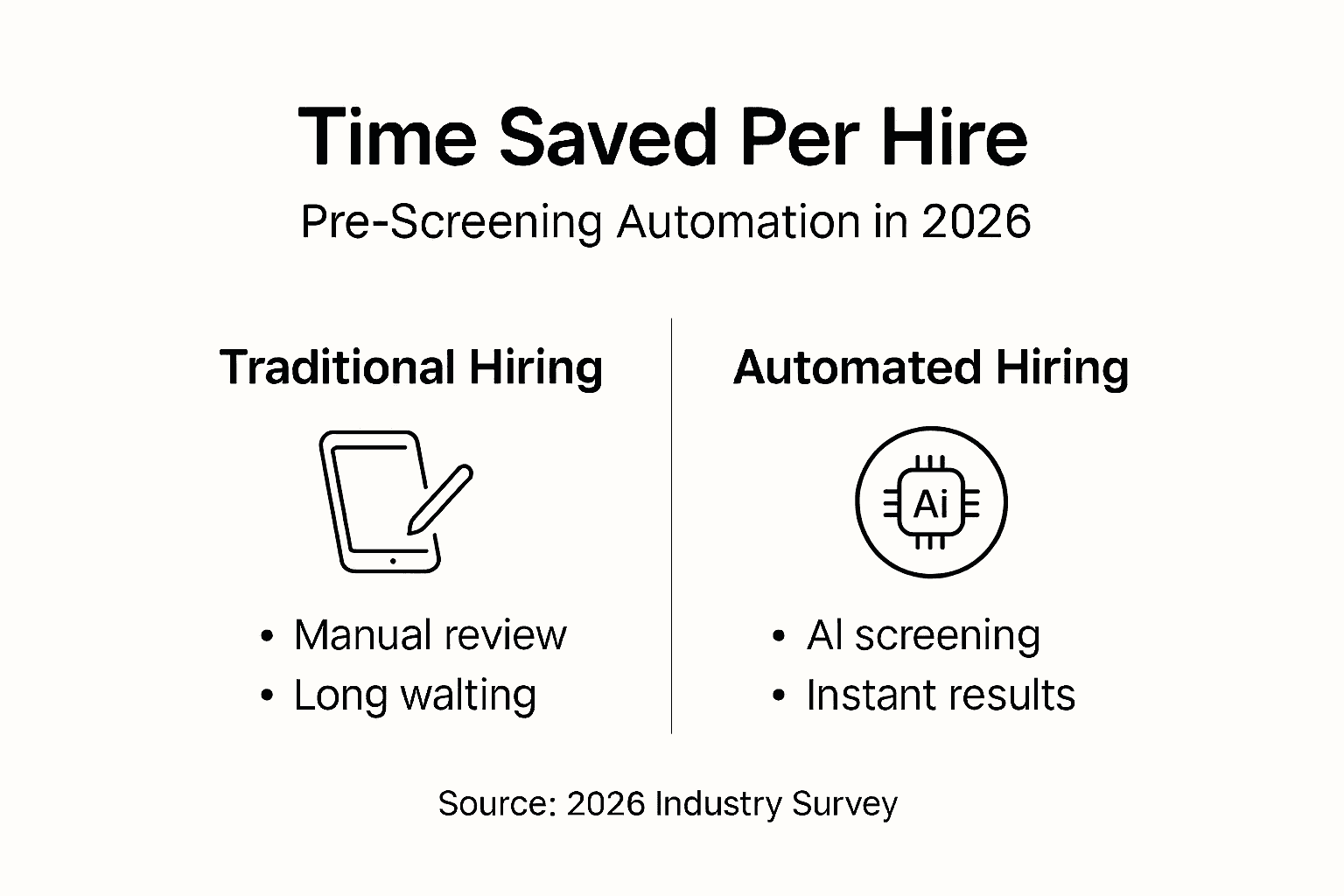
Automated pre-screening can save HR managers up to 23 hours per hire. That’s nearly three full workdays reclaimed for strategic tasks like interviewing top candidates and building relationships. This guide explains what pre-screening automation is, how it works, the benefits and risks you need to know, and practical steps to implement it effectively in your recruitment process.
Table of Contents
- Introduction To Pre-Screening Automation
- How Pre-Screening Automation Works: Mechanisms And Technologies
- Benefits Of Pre-Screening Automation For Recruitment
- Risks, Limitations, And Common Misconceptions
- Comparison Framework: Traditional Vs Automated Pre-Screening
- Practical Implementation And Best Practices
- Conclusion And Future Outlook
- Discover AI-Powered Hiring Solutions With We Are Over The Moon
- Frequently Asked Questions
Key Takeaways
| Point | Details |
|---|---|
| Time Savings | Pre-screening automation saves up to 23 hours per hire and boosts recruiter productivity. |
| Technology | Combines AI assessments, NLP, and video interviews to analyze resumes and soft skills objectively. |
| Bias Reduction | Standardizes evaluation criteria but requires regular auditing to prevent algorithmic bias. |
| Human Balance | Automation handles data tasks while human judgment remains critical for cultural fit assessment. |
| Implementation | Effective use balances technology with ethical hiring practices and candidate experience. |
Introduction to Pre-Screening Automation
Pre-screening automation uses artificial intelligence to evaluate candidates before human interviews. It analyzes applications, tests skills, and assesses fit using technologies like NLP that parse resumes and infer competencies. This creates objective, consistent evaluations that reduce human inconsistencies.
The technology is especially valuable for HR managers handling high application volumes in the Netherlands, UK, and Spain. Rather than manually reviewing hundreds of CVs, you can focus on candidates who genuinely match your requirements. Automation improves precision in matching candidates to job requirements while supporting modern screening workflows that blend efficiency with quality.
Key technologies enabling pre-screening automation include:
- Natural language processing for resume analysis and candidate matching
- Automated cognitive and personality assessments to evaluate aptitude
- Video interview platforms that analyze verbal and non-verbal communication
- Integration with applicant tracking systems for seamless candidate management
- Machine learning algorithms that identify patterns in successful hires
These tools work together to create a comprehensive evaluation framework. They enable multi-layered candidate assessment that goes beyond simple keyword matching. When implemented thoughtfully, automation supports unbiased screening practices that level the playing field for all applicants.
How Pre-Screening Automation Works: Mechanisms and Technologies
AI-powered pre-screening starts with natural language processing that analyzes resumes and extracts relevant qualifications. The technology parses unstructured data like work histories, education credentials, and skills descriptions. It then maps this information against job requirements to identify strong matches.
Automated assessments add depth to this initial screening. Cognitive tests measure problem-solving ability and critical thinking. Personality evaluations gauge traits like conscientiousness and teamwork orientation. Video interview platforms analyze candidate responses for communication skills, confidence, and engagement levels.
The magic happens when these tools integrate with ATS and recruitment platforms for seamless workflow. Candidates receive automated invitations to complete assessments. Results flow directly into your recruitment dashboard. You see ranked candidate lists with detailed insights, not just CVs.
Modern AI recruitment technologies use machine learning to continuously improve matching accuracy. The system learns from your hiring decisions, identifying patterns in successful placements. Over time, it gets better at predicting which candidates will thrive in your organization.
This multi-layered approach reduces manual repetitive tasks dramatically. Instead of reading every application, you review curated shortlists with rich data. AI resume parsing features handle the heavy lifting, freeing your time for strategic conversations with top candidates. The technology speeds up early screening phases while maintaining thoroughness.
Benefits of Pre-Screening Automation for Recruitment
Pre-screening automation saves up to 23 hours per hire by handling resume screening and initial assessments automatically. That time adds up quickly across multiple roles. For a team hiring 20 positions annually, you’re looking at 460 hours reclaimed for higher-value activities.

Productivity gains extend beyond time savings. 90% of businesses use automation software to reduce repetitive hiring tasks and increase recruiter productivity. Your team can focus on interviewing qualified candidates, building talent pipelines, and improving candidate relationships rather than sorting through unsuitable applications.
Consistency and fairness improve when automation standardizes candidate evaluation criteria. Every applicant faces the same assessments and scoring rubrics. This reduces unconscious bias and variability that creep into manual screening. When you screen 200 CVs manually, fatigue and mood fluctuations affect judgment. AI doesn’t get tired or play favorites.
Key benefits for your recruitment process include:
- Faster time to hire through automated candidate ranking and shortlisting
- Improved quality of hire by identifying skills and cultural fit more accurately
- Enhanced candidate experience with prompt communications and engaging assessments
- Better diversity outcomes when algorithms are properly designed and monitored
- Scalability to handle high-volume hiring without proportional staff increases
Communications automation enhances candidate experience significantly. Applicants receive immediate acknowledgment, assessment invitations, and status updates. This keeps them engaged and reflects well on your employer brand. The benefits of AI assessment extend to both recruiters and candidates.
Cultural fit identification improves when you replace CV screening with behavioral assessments and values alignment tools. Traditional CVs tell you what someone has done, not how they work or what drives them. Automation enables deeper insights into candidate motivations and working styles. Bias reduction with AI becomes possible when you focus on demonstrated capabilities rather than credentials alone.
Statistics highlight the impact: Companies using pre-screening automation report 40% faster hiring cycles and 30% improvement in new hire retention. The technology pays for itself quickly through reduced recruiting costs and better placement outcomes.
Risks, Limitations, and Common Misconceptions
Algorithmic bias poses a real risk if AI tools are trained on biased historical data. When your past hiring favored certain demographics, the algorithm may perpetuate those patterns. It learns what worked before, which might include discriminatory practices you’re trying to eliminate. Regular auditing is essential to catch and correct these issues.
Automated assessments alone cannot fully evaluate cultural fit or soft skills. An AI can measure communication clarity in video responses but struggles with empathy, humor, or team chemistry. These human qualities require personal interaction to assess accurately. Technology provides data points, not complete pictures.
Human judgment remains critical to interpret AI insights properly. A hybrid approach combining AI with human judgment reduces depersonalization and better assesses soft skills. Your recruiters need training to understand what AI scores mean and when to override recommendations based on contextual factors the algorithm missed.
Common misconceptions about pre-screening automation include:
- Myth: Automation completely replaces human recruiters. Reality: It handles repetitive tasks while humans make final hiring decisions.
- Myth: AI eliminates all bias from recruitment. Reality: It can reduce bias but also introduces new algorithmic biases if not monitored.
- Myth: Candidates dislike automated screening. Reality: Most appreciate faster responses and engaging assessment formats when implemented well.
- Myth: Automation works the same for all roles. Reality: Different positions require customized assessment criteria and human oversight levels.
Pro Tip: Establish a quarterly AI audit process where your team reviews hiring outcomes by demographic group, assessment type, and algorithm recommendations. Compare AI-selected candidates against those chosen through manual review. This helps you spot bias patterns early and refine your tools. Balance AI and human screening to leverage both efficiency and empathy.
Understanding AI interviews myths helps you set realistic expectations. The technology is powerful but not infallible. Knowing why to use AI interviews and when to supplement with human interaction creates the best outcomes.
Comparison Framework: Traditional vs Automated Pre-Screening
Manual screening requires recruiters to read every CV, compare qualifications against job descriptions, and make subjective judgment calls. It’s time-consuming and varies based on who’s doing the screening. Two recruiters reviewing the same 100 applications might shortlist completely different candidates based on personal preferences and interpretation.
Automated screening processes applications in minutes using consistent criteria. Assessment tools range from resume parsing to cognitive and cultural fit evaluations, creating comprehensive candidate profiles. The system doesn’t tire, get distracted, or let unconscious bias influence decisions.
| Aspect | Traditional Screening | Automated Screening |
|---|---|---|
| Time Investment | Hours per role, manual CV review | Minutes per role, instant analysis |
| Consistency | Varies by recruiter mood and fatigue | Standardized criteria applied uniformly |
| Scalability | Limited by human capacity | Handles thousands of applications easily |
| Assessment Depth | CV and cover letter only | Multiple tests: cognitive, personality, skills, video |
| Bias Risk | Unconscious bias affects decisions | Algorithmic bias requires monitoring |
| Personalization | High touch, personal notes | Automated but can feel impersonal |
| Cost | High labor hours, lower tech costs | Lower labor hours, higher tech investment |
Tradeoffs exist between approaches. Automation delivers speed and consistency but may miss nuanced signals a human would catch. A candidate with an unconventional career path might score poorly algorithmically but impress a recruiter who sees the transferable skills and growth potential.
Automation excels in high-volume hiring scenarios. When you’re filling customer service roles with 500 applicants, automated screening is practically essential. For executive positions with 15 carefully sourced candidates, manual review with light automation support makes more sense.
Pro Tip: Use automation for initial filtering and skills verification, then apply human judgment for cultural fit and final selection. This hybrid model combines the best of both worlds. Start with modern recruitment workflows that layer technology and personal touch strategically.
The right balance depends on your hiring volume, role complexity, and team capacity. Most successful implementations blend automated efficiency with human insight rather than choosing one exclusively.
Practical Implementation and Best Practices
Successful implementation starts with selecting tools aligned with your specific job criteria and company culture. Generic assessment platforms won’t capture what makes candidates successful in your unique environment. Look for solutions that let you customize evaluation criteria, weighting different skills and traits based on role requirements.
Integrate AI assessments with your applicant tracking system to create seamless candidate flow. Data should move automatically between platforms without manual exports and imports. This integration ensures recruiters see complete candidate profiles in one place, combining CV data with assessment results and AI recommendations.
Follow these implementation steps:
- Define clear success criteria for each role, including hard skills, soft skills, and cultural attributes
- Pilot automation on one or two roles to test effectiveness before scaling across all positions
- Train your recruitment team to interpret AI outputs, understanding what scores mean and their limitations
- Establish human review checkpoints where recruiters verify AI recommendations before advancing candidates
- Create feedback loops where hiring outcomes inform algorithm refinement and improvement
- Set up regular bias audits to ensure fair treatment across demographic groups
Recruiter training is crucial for success. Your team needs to understand how algorithms make decisions and when to trust or question recommendations. AI for cultural matching requires human context to work properly. Teach recruiters to spot patterns where AI consistently misses good candidates or flags false positives.
Candidate communications deserve special attention. Automate acknowledgments, assessment invitations, and status updates to keep applicants informed. However, maintain personalized touchpoints for shortlisted candidates. A templated email works for rejections, but top prospects deserve personal outreach that references their specific qualifications.
Best practices for ongoing management include:
- Monitor completion rates and candidate feedback on assessment experiences
- Compare AI-recommended hires against traditional selections to validate effectiveness
- Update evaluation criteria as role requirements evolve
- Test new assessment types periodically to find better predictors of success
- Share anonymized results with hiring managers to build trust in the system
Pro Tip: Start with pilot projects on high-volume, straightforward roles where success is easy to measure. Refine your approach based on real results before tackling complex positions. Document lessons learned and share them across your recruitment team. Build effective screening workflows gradually rather than overhauling everything at once.
Implementation takes patience and iteration. The technology improves as you feed it more data and refine your criteria. Give your team time to adapt and your candidates time to adjust to new assessment formats.
Conclusion and Future Outlook
Pre-screening automation delivers substantial efficiency gains and supports fairer hiring when implemented thoughtfully. The 23-hour time savings per hire translates to meaningful productivity improvements for recruitment teams. Standardized evaluation criteria reduce unconscious bias that creeps into manual screening processes.
Balanced use with human judgment ensures you capture the full picture of candidate potential. AI excels at data processing and pattern recognition. Humans excel at empathy, contextual understanding, and cultural fit assessment. Combining both creates recruitment processes that are fast, fair, and effective.
AI-driven candidate assessment will continue evolving with new innovations in 2026 and beyond. Natural language processing becomes more sophisticated at understanding nuance. Video analysis improves at reading non-verbal cues. Predictive algorithms get better at forecasting job performance and cultural alignment.
Adoption is accelerating among HR teams in the Netherlands, UK, and Spain as the technology matures and proves its value. Early adopters report competitive advantages in attracting top talent faster than rivals. The candidate experience improves when assessment processes are engaging and communications stay prompt.
Now is the time to explore these tools for your organization. Start small, measure results, and scale what works. The recruitment landscape is shifting toward data-driven hiring supported by human expertise. Position your team to thrive in this new environment by embracing automation strategically while preserving the personal touch that makes great hiring decisions.
Discover AI-Powered Hiring Solutions with We Are Over The Moon
Ready to transform your recruitment process with cutting-edge technology? We Are Over The Moon offers specialized AI-powered solutions designed for HR professionals in Europe. Our platform replaces traditional CV screening with comprehensive candidate assessments that reveal true potential.
Explore AI interviews for candidate assessment that analyze communication skills and cultural fit automatically. Leverage cultural AI assessments to identify candidates who will thrive in your unique work environment. Our skills-based hiring solutions combine cognitive tests, company challenges, and video pitches to create complete candidate profiles.
Pro Tip: Visit We Are Over The Moon today to see how AI-driven assessments can reduce your time to hire while improving placement quality. The technology is ready when you are.
Frequently Asked Questions
What is pre-screening automation in recruitment?
Pre-screening automation uses AI tools to quickly evaluate candidate qualifications and fit before human interviews. It streamlines hiring by automating resume parsing, cognitive and personality assessments, and candidate communications. The technology applies consistent criteria across all applicants to identify the strongest matches efficiently.
How does pre-screening automation reduce bias in hiring?
Automation applies consistent evaluation criteria across all candidates, reducing subjective bias from individual recruiters. Every applicant faces identical assessments scored using the same algorithms. However, AI algorithms must be regularly audited to avoid replicating biases present in historical hiring data. Human oversight remains essential to ensure fairness.
Can automation fully replace human recruiters?
Automation handles repetitive and data-heavy screening tasks but does not replace the need for human judgment. Technology excels at processing applications and scoring assessments quickly. Recruiters remain essential for assessing soft skills, evaluating cultural fit, and making final hiring decisions. The best approach combines AI efficiency with human insight.
What are best practices for implementing pre-screening automation?
Align tools with specific job needs and company culture rather than using generic platforms. Integrate assessments with your applicant tracking system for seamless workflow. Train recruitment teams on interpreting AI outputs and maintaining human oversight. Monitor algorithms regularly for fairness and accuracy while building effective screening workflows that balance technology with personal touch.
Recommended
- How to Interview with AI: Cut Hiring Time by 35% in 2026 | We Are Over The Moon
- 6 Key Benefits of AI Interviews for Smarter Hiring | We Are Over The Moon
- How to Screen Without CVs for Better Hiring Results | We Are Over The Moon
- Why Replace CV Screening: Unlocking Better Hires | We Are Over The Moon
- Employee Retention Solutions, Lower Turnover | OpenElevator