What Is Unbiased Screening and Why It Matters

Recruiting top talent in a Western European tech startup often means battling unconscious bias and outdated evaluation practices. The need for unbiased screening is pressing as organisations strive to create fairer, more objective hiring processes. By adopting structured methods, anonymising candidate profiles, and deploying algorithmic assessment tools, companies can focus on skills and potential rather than demographic details. This guide breaks down practical strategies and highlights the innovative tools that help eliminate bias from recruitment.
Table of Contents
- Defining Unbiased Screening In Recruitment
- Types Of Bias And Common Misconceptions
- How Unbiased Screening Processes Work
- Ai, Technology, And Modern Screening Tools
- Legal Considerations And Compliance Factors
- Pitfalls To Avoid And Practical Best Practices
Key Takeaways
| Point | Details |
|---|---|
| Unbiased Screening | A systematic approach in recruitment that focuses on merit and job-relevant competencies while minimising subjective biases. |
| Types of Bias | Understanding unconscious bias and its various forms is crucial for creating equitable recruitment practices. |
| Technological Innovations | AI and algorithmic screening tools enhance objectivity by focusing on skills and competencies, thereby reducing bias. |
| Legal Compliance | Developing processes that comply with anti-discrimination laws is essential to protect candidates’ rights and ensure fair evaluations. |
Defining Unbiased Screening in Recruitment
Unbiased screening represents a transformative approach in modern recruitment, designed to minimise discriminatory practices and create fair candidate evaluation processes. At its core, this method aims to neutralise subjective human judgments that might inadvertently disadvantage certain candidates based on demographic characteristics.
According to research examining fairness in recruitment applications, unbiased screening involves developing systematic processes that evaluate candidates purely on merit and job-relevant competencies. These methods deliberately remove identifiable personal information that could trigger unconscious prejudices.
Key characteristics of unbiased screening include:
- Standardised evaluation criteria
- Anonymised candidate profiles
- Structured assessment frameworks
- Data-driven selection processes
- Algorithmic screening techniques
The structured screening methodology provides a nuanced approach to reducing ethnic and demographic discrimination. By separating specific candidate attributes and creating uniform evaluation protocols, organisations can dramatically improve the objectivity of their recruitment strategies.
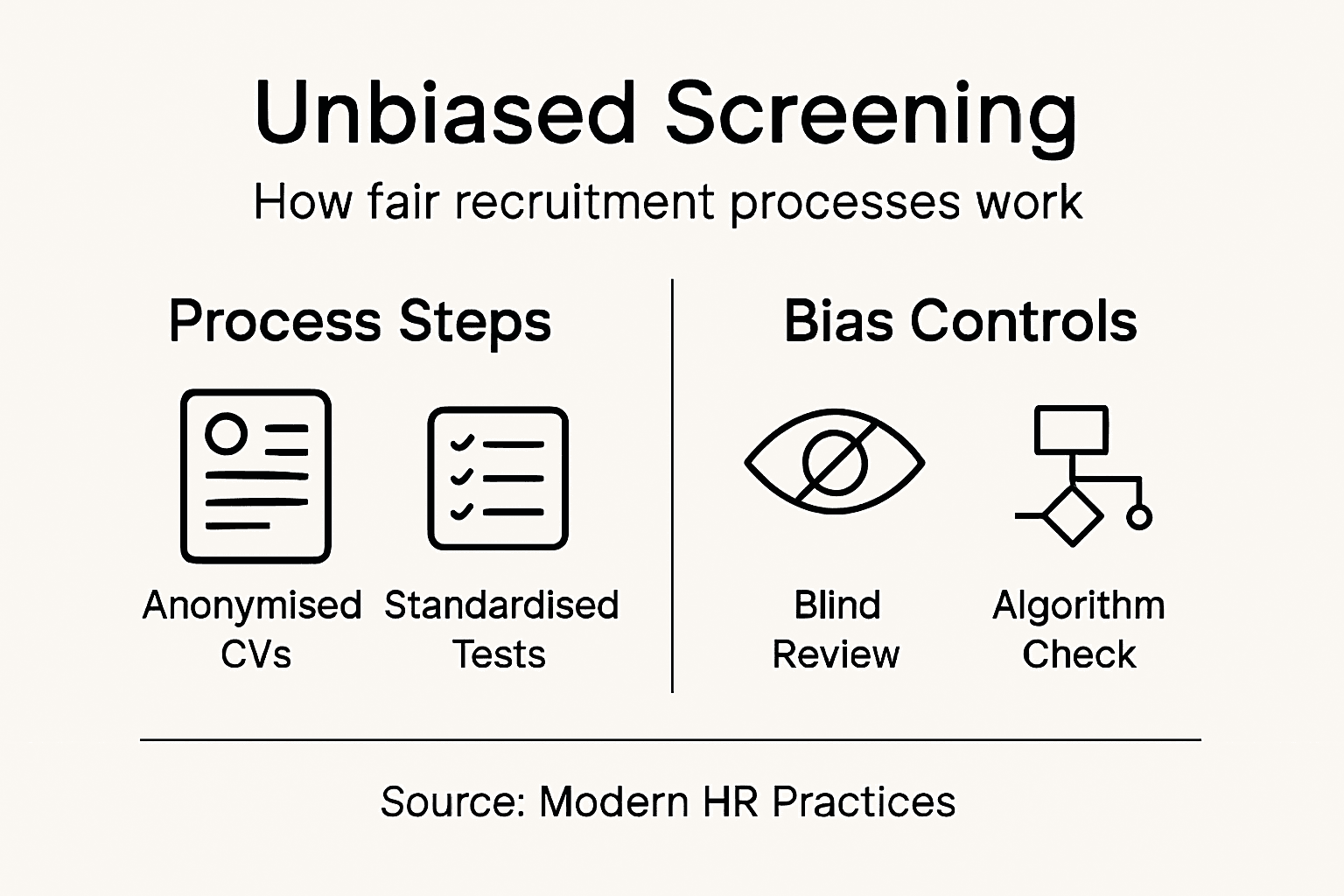
Technological innovations now enable sophisticated screening techniques that minimise human bias. Machine learning algorithms can be programmed to focus exclusively on skills, qualifications, and performance potential, effectively removing demographic variables from initial candidate assessments.
Pro tip: Implement blind recruitment practices by removing names, photographs, and demographic indicators from initial application screening to ensure a genuinely objective candidate evaluation process.
Types of Bias and Common Misconceptions
Bias in recruitment is a complex phenomenon that extends far beyond simplistic understandings. Unconscious bias represents a nuanced psychological mechanism where individuals make involuntary judgments based on deeply ingrained stereotypes and preconceived notions, often without realising their discriminatory impact.
Research exploring conceptual definitions of bias highlights critical misconceptions about how bias operates in organisational contexts. Many professionals mistakenly believe that bias is always intentional, when in reality, most discriminatory practices stem from subtle, unintentional cognitive processes.
Primary types of recruitment bias include:
- Confirmation bias: Seeking information that validates pre-existing beliefs about candidates
- Affinity bias: Preferring candidates who seem similar to oneself
- Gender bias: Unconsciously favouring candidates of a specific gender
- Age bias: Discriminating against candidates based on perceived generational differences
- Educational bias: Overemphasising academic credentials
A significant misconception is that bias only affects marginalised groups. In reality, bias can disadvantage candidates from any demographic background, creating systemic inequities that undermine talent acquisition processes.
Technological solutions are emerging to address these complex challenges. Advanced algorithmic screening tools can help neutralise human biases by focusing exclusively on objective, job-relevant competencies and eliminating identifying personal information during initial candidate assessments.
Pro tip: Implement regular unconscious bias training and use anonymised candidate screening techniques to minimise unintentional discriminatory practices in recruitment.
The table below outlines common types of bias and how modern technology helps offset their impact:
| Bias Type | Impact in Recruitment | Technological Mitigation |
|---|---|---|
| Confirmation bias | Reinforces stereotypes | Algorithms ignore prior beliefs |
| Affinity bias | Favouring similar candidates | AI anonymises profiles |
| Gender bias | Leads to unequal opportunities | Removes gender indicators |
| Age bias | Excludes certain age groups | Focuses on competencies only |
| Educational bias | Overvalues certain institutions | Assesses skills, not credentials |
How Unbiased Screening Processes Work
Unbiased screening represents a sophisticated approach to candidate evaluation that systematically eliminates potential discriminatory factors during recruitment. This process involves multiple strategic interventions designed to create a fair, objective selection mechanism that focuses exclusively on job-relevant competencies and potential.

Research on fair selection processes demonstrates that structured methodologies can dramatically reduce unconscious bias and improve organisational talent acquisition strategies. By implementing carefully designed screening protocols, companies can transform their recruitment landscape.
Key components of unbiased screening processes typically include:
- Anonymisation of candidate personal details
- Standardised assessment criteria
- Algorithmic competency matching
- Blind resume review techniques
- Structured interview frameworks
- Objective skills-based evaluation
Effective unbiased screening prioritises candidate potential over demographic characteristics, creating a more equitable recruitment environment.
Technological innovations have dramatically enhanced screening objectivity. Machine learning algorithms can now analyse candidate profiles using sophisticated neural networks that focus exclusively on skills, experience, and performance potential while completely removing identifiable personal information.
The screening process generally follows a structured progression:
- Initial anonymisation of candidate information
- Skills and competency assessment
- Objective performance potential evaluation
- Algorithmic matching against job requirements
- Structured candidate shortlisting
Pro tip: Implement multi-stage screening processes with blind evaluation techniques to ensure consistent, objective candidate assessment across all recruitment stages.
AI, Technology, and Modern Screening Tools
Artificial Intelligence (AI) has revolutionised recruitment technologies, offering unprecedented capabilities in candidate evaluation and screening processes. These advanced technological solutions transform traditional hiring methodologies by introducing sophisticated, data-driven approaches that minimise human bias and enhance selection accuracy.
Research examining fairness in AI-driven recruitment reveals complex challenges and innovative strategies for developing more equitable screening tools. Machine learning algorithms now possess remarkable capabilities to analyse candidate profiles while mitigating potential discriminatory practices.
Key technological innovations in screening tools include:
- Natural language processing for resume analysis
- Algorithmic skill matching systems
- Anonymised candidate profile evaluations
- Predictive performance modelling
- Machine learning bias detection mechanisms
- Intelligent competency assessment frameworks
AI screening technologies represent a paradigm shift in recruitment, prioritising objective skill assessment over subjective human judgments.
The emerging landscape of AI recruitment technologies focuses on developing advanced screening methodologies that balance efficiency with ethical considerations. Sophisticated neural networks can now extract nuanced insights from candidate data while maintaining strict anonymity and preventing unconscious bias infiltration.
Technological approaches to unbiased screening typically involve:
- Data anonymisation
- Algorithmic skill matching
- Contextual competency evaluation
- Transparent decision-making processes
- Continuous bias monitoring
Pro tip: Regularly audit AI screening algorithms for potential hidden biases and maintain transparent, explainable machine learning models to ensure ethical candidate assessment.
Here is a summary showing how AI-driven screening compares with traditional recruitment methods:
| Aspect | AI-Driven Screening | Traditional Screening |
|---|---|---|
| Bias Risk | Lower due to anonymisation | Higher from subjective judgement |
| Evaluation Speed | Rapid, automated processing | Manual, time-consuming review |
| Assessment Consistency | Uniform with algorithms | Variable by evaluator |
| Focus | Skills and competencies | May include demographic factors |
| Compliance Management | Easier to track and audit | More challenging to document |
Legal Considerations and Compliance Factors
Legal compliance in unbiased screening represents a critical foundation for organisations seeking to develop ethical and defensible recruitment practices. Navigating the complex landscape of employment regulations requires a comprehensive understanding of anti-discrimination frameworks and their practical implementation in talent acquisition strategies.
The LIBRA Recruitment Handbook guidelines provide comprehensive insights into creating legally robust recruitment processes that prioritise fairness and transparency. These recommendations emphasise the importance of developing systematic approaches that protect candidate rights and organisational integrity.
Key legal compliance considerations include:
- Protection of candidates’ personal data
- Adherence to equal employment opportunity regulations
- Transparent selection criteria documentation
- Consistent application of evaluation standards
- Comprehensive record-keeping practices
- Regular compliance audits
Legal frameworks demand more than passive non-discrimination; they require proactive mechanisms to ensure genuine equity in recruitment processes.
Research on fair selection legal standards highlights the critical importance of developing structured, objective evaluation methods. These approaches help organisations mitigate potential legal risks associated with discriminatory hiring practices while fostering a more inclusive workplace environment.
Organisations must address compliance through:
- Developing clear, objective selection criteria
- Training hiring managers on legal requirements
- Implementing standardised assessment protocols
- Maintaining comprehensive documentation
- Conducting regular bias and compliance reviews
Pro tip: Consult with legal experts specialising in employment law to develop robust, compliant recruitment screening processes that protect both candidate rights and organisational interests.
Pitfalls To Avoid and Practical Best Practices
Implementing unbiased screening requires strategic navigation of complex organisational challenges. Successful recruitment strategies demand sophisticated approaches that proactively address potential bias while maintaining rigorous candidate evaluation standards.
Common pitfalls in unbiased screening can significantly undermine organisational efforts to create equitable recruitment processes. These challenges often emerge from unconscious cognitive biases, inadequate technological implementations, and inconsistent evaluation methodologies.
Major pitfalls organisations must carefully avoid include:
- Relying exclusively on traditional resume screening
- Maintaining inconsistent evaluation criteria
- Failing to train hiring managers on bias recognition
- Overlooking algorithmic bias in technological tools
- Neglecting continuous process improvement
- Insufficient documentation of screening rationales
Effective unbiased screening requires persistent vigilance, continuous learning, and systematic approach refinement.
Practical best practices for implementing robust, fair screening processes involve developing comprehensive, multifaceted strategies that address both human and technological dimensions of recruitment. These approaches prioritise transparency, objectivity, and consistent evaluation methodologies.
Key implementation strategies include:
- Developing standardised candidate assessment frameworks
- Implementing blind screening technologies
- Creating diverse hiring evaluation panels
- Establishing clear, measurable selection criteria
- Conducting regular bias impact assessments
Pro tip: Develop a structured feedback mechanism that allows continuous refinement of screening processes, enabling ongoing improvement and adaptation to emerging best practices.
Transform Your Recruitment with Truly Unbiased Screening
Understanding the complexities of unbiased screening reveals one major truth: relying solely on traditional CV reviews often leaves unconscious bias unchecked. If you seek to overcome challenges like confirmation bias, affinity bias or gender bias and want to prioritise skills, potential and cultural fit, then replacing old screening methods with real assessments is vital. The article highlights how anonymised profiles, structured evaluations and AI-driven tools create fairer, more objective hiring.
Explore how you can eliminate subjective judgements and level the playing field with innovative solutions that harness AI interviews, company challenges, cognitive tests and video pitches. Visit WAOTM to discover a holistic approach to recruitment that aligns perfectly with the need for unbiased screening showcased in the article. Take the critical next step now by trying a platform designed to deliver consistent, fair and data-driven candidate evaluations at WAOTM. Learn more about how to revolutionise hiring and say goodbye to biased CV screening by visiting Replace CV Screening with Real Assessments.
Make your recruitment processes transparent, objective and truly inclusive with WAOTM’s cutting-edge technology. Start today and experience the difference that unbiased, modern screening can make.
Frequently Asked Questions
What is unbiased screening in recruitment?
Unbiased screening is a recruitment approach that aims to minimise discriminatory practices by evaluating candidates purely on merit and job-related competencies, thus neutralising subjective human judgments.
Why is unbiased screening important in hiring processes?
Unbiased screening is crucial as it creates fair evaluation processes, enhances objectivity, and reduces the impact of unconscious bias, leading to a more equitable recruitment environment and improved talent acquisition.
How do companies implement unbiased screening methods?
Companies implement unbiased screening by using techniques such as anonymising candidate profiles, standardising assessment criteria, employing algorithmic screening, and applying structured assessment frameworks during the recruitment process.
What role does technology play in unbiased screening?
Technology, particularly AI and machine learning, plays a significant role in unbiased screening by offering tools that assess candidates based solely on skills and qualifications, thereby reducing the influence of unconscious bias and improving selection accuracy.