Why test cultural intelligence to transform recruitment

TL;DR:
- Cultural intelligence (CQ) enables effective collaboration across diverse teams and reduces turnover.
- Testing for CQ early in recruitment improves team integration, innovation, and long-term retention.
- Validated tools like simulations and psychometric assessments help reliably measure and develop CQ skills.
Most HR professionals are over the moon when a candidate ticks every technical box. Strong CV, solid experience, impressive qualifications. Yet teams still struggle. Collaboration breaks down, integration stalls, and turnover creeps up. The missing piece is often cultural intelligence (CQ), the ability to function effectively across different cultural contexts. Unlike a degree or a skill set, CQ shapes how people connect, adapt, and contribute in diverse teams. For HR professionals in the Netherlands, UK, and Spain, where multicultural workplaces are the norm, testing for CQ during recruitment is fast becoming one of the smartest moves you can make.
Table of Contents
- What is cultural intelligence and why does it matter
- Key benefits of testing for cultural intelligence in recruitment
- How to test cultural intelligence: methods, tools, and best practices
- Integrating cultural intelligence results into your recruitment strategy
- What most HR teams miss about cultural intelligence testing
- How We Are Over The Moon helps you harness cultural intelligence
- Frequently asked questions
Key Takeaways
| Point | Details |
|---|---|
| Cultural intelligence defined | Cultural intelligence (CQ) is the ability to effectively navigate diverse cultural contexts, which is crucial for global teams. |
| Tangible benefits | Testing for CQ leads to lower turnover, better integration, and higher team performance. |
| Practical assessment | Validated tools like simulations and structured interviews make CQ testing accessible for HR professionals. |
| Strategic integration | Incorporating CQ results into hiring and onboarding creates lasting organisational benefits. |
What is cultural intelligence and why does it matter
Cultural intelligence, commonly known as CQ, is a person’s capability to relate and work effectively in culturally diverse situations. It goes well beyond awareness of different customs or speaking a second language. CQ is a measurable, learnable capability made up of four distinct components.
- Metacognitive CQ: How a person plans and reflects on cultural interactions before, during, and after they happen.
- Motivational CQ: The drive and confidence to engage with people from different cultural backgrounds.
- Behavioural CQ: The ability to adapt verbal and non-verbal actions to suit different cultural settings.
- Cognitive CQ: Knowledge of cultural norms, values, and practices across different groups.
These four components work together. A candidate might score highly on cognitive CQ, knowing a lot about other cultures, but lack the motivational drive to actually engage. That gap matters enormously in real team settings.
In modern organisations across the Netherlands, UK, and Spain, teams are increasingly multinational. Remote work has made this even more pronounced. A hiring decision that ignores CQ is essentially hiring blind to one of the most important dimensions of workplace performance.
Traditional organisational culture fit assessments ask whether a candidate mirrors your existing team’s values. CQ assessments ask something far more powerful: can this person adapt, grow, and collaborate across differences? That shift in question changes everything about who you hire and why.
Research backs this up strongly. CQ increases self-efficacy in participants who engage with cultural intelligence development programmes, including simulation-based tools. Self-efficacy, the belief in one’s ability to succeed, is a strong predictor of performance and resilience at work.
Statistic spotlight: Studies using the Ecotonos simulation found measurable gains in both CQ and self-efficacy among participants, suggesting that CQ is not fixed but actively developable.
Pro Tip: Don’t save CQ assessment for the final round. Introduce it early in your recruitment process so it informs every subsequent conversation and decision.
Key benefits of testing for cultural intelligence in recruitment
Once you understand what CQ is, the case for testing it becomes very exciting. The organisational benefits are real, measurable, and directly relevant to the challenges HR professionals face every day.
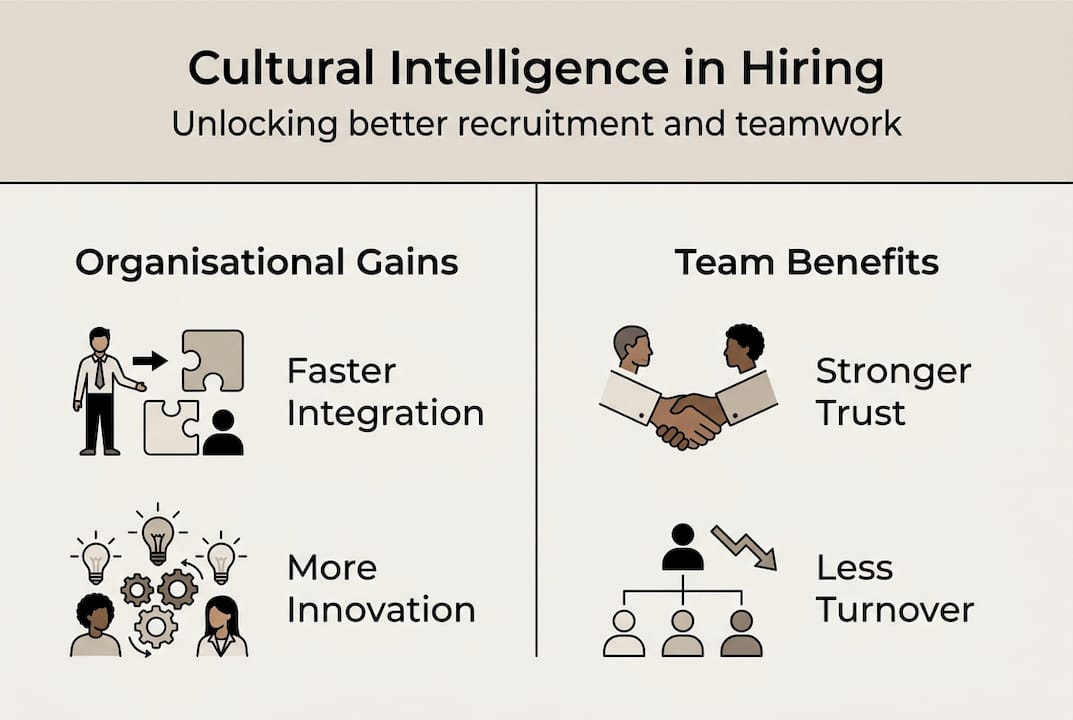
Here is a quick comparison of what recruitment looks like with and without CQ testing:
| Factor | Without CQ testing | With CQ testing |
|---|---|---|
| Team integration | Slower, more friction | Faster, smoother |
| Cross-cultural collaboration | Inconsistent | Structured and supported |
| Staff turnover | Higher in diverse teams | Noticeably reduced |
| Candidate self-efficacy | Unknown at hiring | Assessed and developed |
| Onboarding effectiveness | Generic | Tailored to CQ profile |
The benefits go beyond the hiring decision itself. CQ testing boosts self-efficacy and collaborative outcomes in teams, which means the impact carries through into daily work, project delivery, and long-term retention.

For HR professionals focused on cutting tech turnover or improving integration in fast-growing teams, CQ testing offers a structured, evidence-based lever to pull.
Here are the top benefits worth celebrating:
- Lower turnover: Candidates with high CQ adapt more readily, reducing the friction that leads to early exits.
- Stronger team cohesion: CQ-aware teams navigate conflict and difference more constructively.
- Better client relationships: In client-facing roles, CQ directly improves communication and trust.
- Faster onboarding: When you know a candidate’s CQ profile, you can tailor their integration plan from day one.
- Improved innovation: Diverse teams with high collective CQ generate more creative solutions.
A practical fit assessment guide can help you build CQ into your existing frameworks without starting from scratch. The goal is not to replace your current process but to enrich it with a dimension that CVs simply cannot reveal.
How to test cultural intelligence: methods, tools, and best practices
Knowing CQ matters is one thing. Knowing how to assess it reliably is where many HR teams get stuck. The good news is that validated methods exist, and they are more accessible than you might think.
Here are the most effective steps to integrate CQ assessment into your hiring workflow:
- Define the CQ requirements for the role. Not every role demands the same level of cultural adaptability. A team lead managing a multinational group needs higher behavioural CQ than a solo technical contributor.
- Choose a validated assessment tool. Options range from psychometric tests to structured behavioural interviews to simulation-based tools.
- Run the assessment at the right stage. Early-stage screening can use lighter-touch tools, while final-round assessments can go deeper.
- Score and contextualise results. CQ scores should be read alongside role requirements and team dynamics, not in isolation.
- Feed results into onboarding. Use CQ profiles to shape how new hires are introduced to the team and the organisation.
The Ecotonos simulation game is one of the most well-validated tools for developing and assessing CQ competencies. It places participants in realistic cross-cultural scenarios and measures how they respond, adapt, and reflect.
Here is a quick overview of popular tools and their best use cases:
| Tool | Type | Best use case |
|---|---|---|
| Ecotonos simulation | Scenario-based game | Deep CQ development and assessment |
| CQ Scale (psychometric) | Self-report questionnaire | Screening and benchmarking |
| Structured behavioural interview | Interview framework | Contextual, role-specific CQ probing |
| AI-powered cultural assessment | Digital platform | Remote hiring and large-scale screening |
A solid fit checklist in hiring ensures you don’t miss key CQ indicators during interviews. Pairing that with AI and cultural fit tools makes the whole process faster and more consistent, especially for high-volume hiring.
Pro Tip: For remote hiring across the Netherlands, UK, and Spain, adapt your CQ assessments to be fully digital. Scenario-based tools and video-response formats work brilliantly for distributed teams.
Integrating cultural intelligence results into your recruitment strategy
Assessing CQ is only half the job. The real value comes from using those results wisely throughout your recruitment and onboarding strategy.
CQ enhances team dynamics and self-efficacy, which means CQ data should actively inform your hiring decisions and team-building practices, not just sit in a spreadsheet.
Here are practical frameworks for putting CQ results to work:
- Weight CQ alongside skills and experience. Decide in advance what proportion of your hiring decision CQ will influence. For cross-functional or client-facing roles, weight it higher.
- Map CQ profiles to team gaps. If your existing team scores low on motivational CQ, prioritise candidates who score strongly in that area.
- Use CQ data to personalise onboarding. A candidate with strong cognitive CQ but lower behavioural CQ might benefit from role-play scenarios during onboarding.
- Build feedback loops. Track how CQ scores correlate with performance and retention over time. This data becomes your strongest internal business case.
- Share CQ insights with line managers. They are the ones who will work with the new hire daily, so give them the context to support integration effectively.
“Cultural intelligence isn’t a soft skill. It’s a strategic capability that shapes how teams perform under pressure, across borders, and through change.” HR Director, multinational technology firm
Using company culture with AI tools helps you match CQ profiles to team environments with far greater precision than manual review alone.
Pro Tip: Avoid treating CQ scores as pass or fail. A lower score in one component often signals a development opportunity, not a disqualification. Contextualise every result by role, team, and growth potential.
What most HR teams miss about cultural intelligence testing
Here is the uncomfortable truth: most HR teams use CQ as a filter rather than a lens. They screen candidates in or out based on a score, then move on. That misses the point entirely.
CQ testing reveals latent potential that assessments outperform CVs in capturing. A candidate with moderate CQ scores but high metacognitive awareness is someone who knows how to learn and adapt. That is enormously valuable. A CV will never show you that.
We also see teams fixate on generic culture fit, asking whether someone feels like a match, rather than asking whether they can grow with a diverse, evolving organisation. Those are very different questions with very different answers.
The missed opportunity is using CQ data to shape onboarding, mentoring, and team development. When you know where someone’s CQ strengths and gaps lie, you can build a genuinely personalised integration plan. That is where CQ moves from a recruitment tool to a strategic advantage. Reframe it that way and you will be over the moon with the results.
How We Are Over The Moon helps you harness cultural intelligence
Taking the next step with cultural intelligence is easier with the right guidance and resources.
At We Are Over The Moon, we help HR professionals replace outdated CV screening with real, meaningful assessments. From AI-powered interviews and company challenges to cultural matching tools and cognitive tests, our platform is built for modern recruitment. We are genuinely excited about what CQ-driven hiring can do for your teams. Want to see how our approach works? Explore our tools and discover a smarter, more human way to find the right people for your organisation.
Frequently asked questions
What is the difference between cultural fit and cultural intelligence?
Cultural fit focuses on aligning with existing norms, while CQ measures adaptability across diverse cultures. CQ goes beyond static fit to foster genuine collaboration and growth.
Can CQ testing really improve team dynamics and reduce turnover?
Yes, research shows that CQ assessment supports integration and lowers turnover, particularly in multicultural workplaces where adaptability is essential.
Are there proven methods for assessing cultural intelligence in recruitment?
Absolutely. Tools like the Ecotonos simulation and validated psychometric assessments are widely used and well-evidenced for measuring CQ in hiring contexts.
How can CQ results be used after hiring?
CQ results guide onboarding and team integration strategies, helping managers personalise development plans and support new hires more effectively from day one.