Why Use AI Interviews: Enhancing Recruitment Outcomes

Every hiring cycle brings tough questions about choosing candidates who genuinely fit your company and team. Uncertainty can grow when technology promises to make this easier but also creates new doubts. For HR managers at Dutch tech startups, understanding AI interviews goes beyond handling digital tools—it means breaking through persistent myths and assumptions about how algorithmic assessments really work. This article gives clarity on what AI interviews offer, how they shift recruitment practices, and addresses misconceptions that might hold you back from effective implementation.
Table of Contents
- Defining AI Interviews and Common Myths
- Key Types of AI Interview Assessments
- How AI Interviews Transform Recruitment
- AI Interviews and Bias Reduction in Hiring
- Compliance, Privacy, and Implementation Challenges
Key Takeaways
| Point | Details |
|---|---|
| AI Interviews Enhance Recruitment | These technologies provide objective, data-driven evaluations, improving candidate assessment and reducing biases in hiring. |
| Supplement Human Expertise | AI tools are designed to enhance human decision-making rather than replace it, requiring continuous oversight during implementation. |
| Diverse Assessment Types | AI interviews leverage various assessments including behavioural and cognitive evaluations to gain a holistic view of candidates’ skills and potentials. |
| Compliance and Ethics Are Crucial | Organisations must navigate complex legal frameworks and ensure transparent practices to protect candidate privacy and maintain algorithmic accountability. |
Defining AI Interviews and Common Myths
AI interviews represent a sophisticated technology designed to transform recruitment processes by utilising advanced algorithmic assessments. These digital interactions go beyond traditional screening methods, enabling organisations to evaluate candidate potential through intelligent, data-driven evaluations.
Understanding AI interviews requires dispelling several prevalent misconceptions. Comprehensive research on AI myths highlights several critical misunderstandings that prevent effective implementation:
- AI interviews are NOT fully autonomous decision-makers
- They supplement, not replace, human recruitment expertise
- These tools analyse communication patterns, not personal identity
- Algorithmic assessments remain transparent and explainable
Common myths surrounding AI interviews often stem from misunderstandings about technological capabilities. Many professionals incorrectly assume these systems are inscrutable “black boxes” designed to replace human judgment. In reality, AI interview technologies are nuanced tools crafted to enhance, not eliminate, human decision-making processes.
Key Differentiators of AI Interviews:
Here’s a comparison of traditional and AI-driven interview processes to illustrate their distinct advantages:
| Aspect | Traditional Interviews | AI-Driven Interviews |
|---|---|---|
| Evaluation Approach | Subjective, intuition-based | Data-driven, algorithmic |
| Speed of Screening | Slow, manual | Rapid, automated |
| Bias Mitigation | Prone to unconscious bias | Designed to reduce bias |
| Assessment Consistency | Varies with interviewer | Standardised for all candidates |
| Skill Measurement | Often surface-level | Holistic and in-depth |
- Objective candidate evaluation
- Standardised assessment criteria
- Reduction of unconscious human bias
- Faster screening processes
- Data-driven insights
AI interviews provide structured, consistent evaluation mechanisms that democratise recruitment by focusing on skills and potential rather than superficial characteristics.
Pro tip: When implementing AI interviews, always maintain human oversight and ensure the technology aligns with your organisation’s specific cultural and professional requirements.
Key Types of AI Interview Assessments
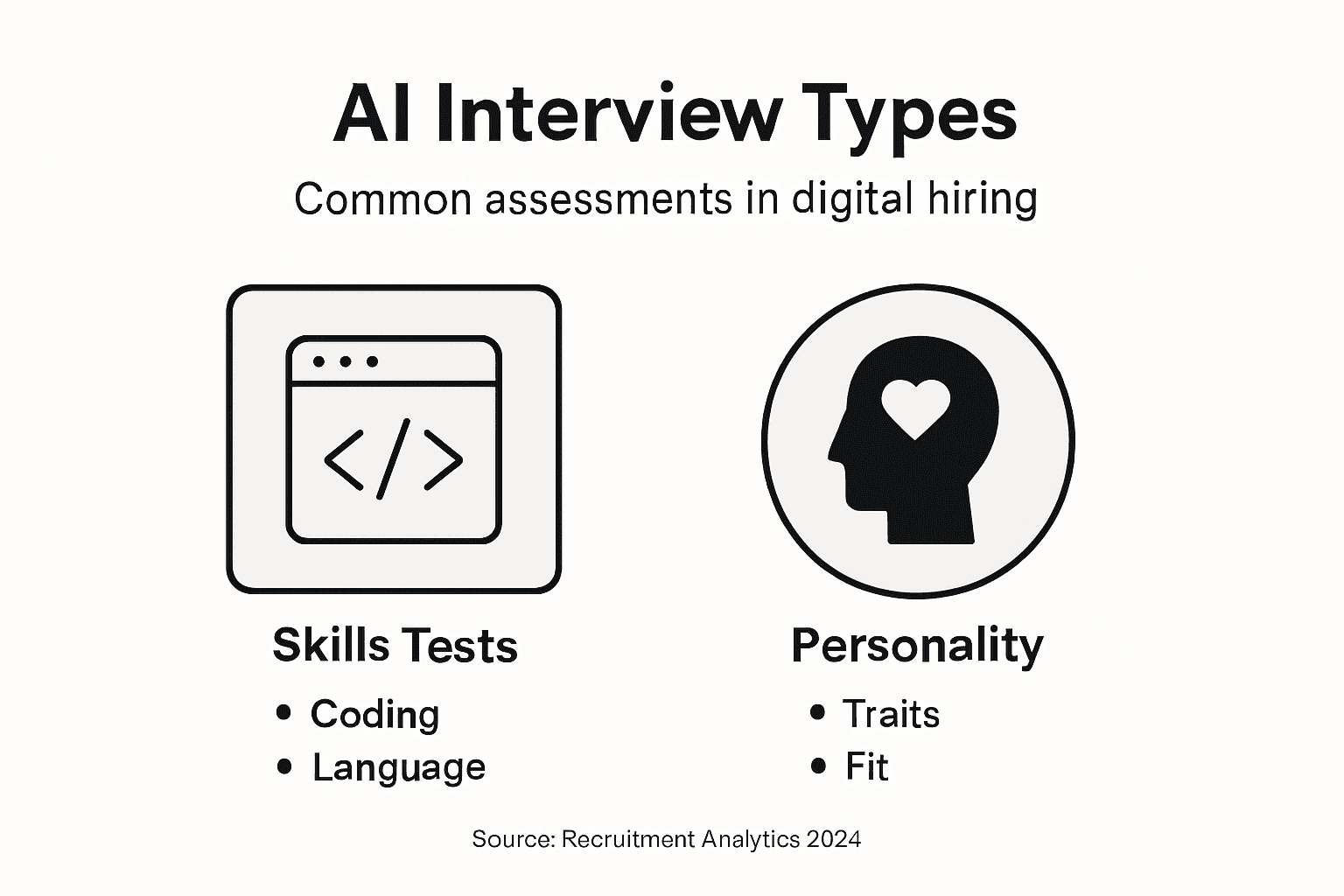
AI interview assessments have revolutionised recruitment by offering sophisticated evaluation mechanisms that go beyond traditional screening methods. Advanced mock interview techniques enable organisations to conduct comprehensive candidate evaluations with unprecedented efficiency and objectivity.
Primary Categories of AI Interview Assessments:
- Behavioural Assessments: Analyse communication styles, emotional intelligence, and interpersonal skills
- Technical Skills Evaluations: Test specific professional competencies through targeted algorithmic challenges
- Situational Judgment Tests: Simulate real-world scenarios to assess problem-solving and decision-making capabilities
- Cognitive Ability Screenings: Measure critical thinking, logical reasoning, and adaptability
Each assessment type serves a unique purpose in understanding candidate potential. Behavioural assessments, for instance, utilise natural language processing to examine communication patterns, tone, and emotional nuances that traditional interviews might overlook. Technical evaluations can instantaneously assess coding skills, technical knowledge, or specialised expertise through adaptive testing algorithms.
Key Evaluation Parameters:
- Response quality and complexity
- Time management during assessments
- Consistency in problem-solving approaches
- Depth of technical understanding
- Adaptability to unexpected challenges
AI interview assessments provide a data-driven approach to candidate evaluation, transforming subjective recruitment processes into measurable, objective selection strategies.
Pro tip: Design your AI interview assessments to complement, not replace, human insights by creating multi-dimensional evaluation frameworks that capture both technical skills and cultural alignment.
How AI Interviews Transform Recruitment
AI-powered recruitment strategies are fundamentally reshaping how organisations identify, assess, and select top talent. By leveraging advanced algorithmic techniques, these innovative approaches are moving beyond traditional hiring methodologies, creating more inclusive, efficient, and data-driven recruitment processes.
Key Transformative Elements:
- Elimination of unconscious human bias
- Standardised candidate evaluation frameworks
- Enhanced candidate experience and engagement
- Faster and more accurate screening processes
- Holistic skills assessment beyond traditional CV screening
The technological revolution in recruitment goes far deeper than simple automation. Modern AI interview systems utilise sophisticated natural language processing, machine learning algorithms, and predictive analytics to provide nuanced insights into candidate potential that conventional interviews often miss. These systems can analyse communication patterns, emotional intelligence, problem-solving approaches, and technical competencies with unprecedented precision.
Recruitment Transformation Dimensions:
- Objectivity in candidate assessment
- Expanded candidate discovery
- Reduced time-to-hire
- Improved matching accuracy
- Cost-effective talent acquisition
AI interviews represent a paradigm shift from subjective, intuition-based hiring to data-driven, scientifically validated talent selection strategies.
Pro tip: Integrate AI interview technologies gradually, maintaining human oversight and continuously calibrating algorithms to ensure fair, comprehensive candidate evaluations.
AI Interviews and Bias Reduction in Hiring
Contemporary hiring research reveals that AI interviews represent a nuanced approach to reducing unconscious human bias in recruitment processes. By implementing structured, standardised assessment frameworks, organisations can create more equitable candidate evaluation mechanisms that prioritise skills, potential, and objective performance indicators.
Key Mechanisms for Bias Reduction:
- Anonymised candidate screening
- Standardised evaluation criteria
- Algorithmic skill assessment
- Consistent interview question design
- Transparent scoring mechanisms
Traditional recruitment approaches often inadvertently introduce subtle biases related to gender, ethnicity, age, and socioeconomic background. AI interview technologies counteract these limitations by focusing exclusively on measurable competencies, communication effectiveness, and demonstrated problem-solving capabilities. The algorithmic approach removes subjective human interpretations that frequently compromise fair candidate selection.
Bias Mitigation Strategies:
- Implement blind assessment protocols
- Use diverse training data for AI models
- Regularly audit algorithmic decision-making
- Maintain human oversight
- Continuously refine evaluation frameworks
AI interviews represent a sophisticated mechanism for creating more inclusive, merit-based recruitment processes that transcend human limitations and unconscious prejudices.
Pro tip: Develop a comprehensive bias audit process that regularly evaluates your AI interview algorithms for potential systemic inequities and ensures continuous improvement in fairness and inclusivity.

Compliance, Privacy, and Implementation Challenges
Global AI governance frameworks reveal complex regulatory landscapes surrounding AI interview technologies. Organisations must navigate intricate legal requirements, data protection standards, and ethical considerations that extend far beyond traditional recruitment compliance mechanisms.
Critical Compliance Dimensions:
- Data protection regulations
- Candidate consent protocols
- Algorithmic transparency requirements
- Individual privacy safeguards
- Cross-border data transfer limitations
Implementing AI interview technologies requires a sophisticated, multi-layered approach to managing potential legal and ethical risks. Companies must develop robust governance frameworks that balance technological innovation with comprehensive privacy protection. This involves creating transparent systems that enable candidates to understand how their personal information is processed, analysed, and potentially stored.
The following table summarises the main compliance challenges and recommended solutions when implementing AI interviews:
| Compliance Challenge | Recommended Solution |
|---|---|
| Data privacy protection | Enforce strong encryption and access controls |
| Algorithmic transparency | Publish clear decision criteria |
| Candidate consent | Use explicit, multi-step agreements |
| Cross-border data transfers | Adopt international compliance frameworks |
| Discrimination prevention | Regular audits and model updates |
Key Implementation Challenges:
- Ensuring comprehensive data protection
- Maintaining algorithmic accountability
- Protecting candidate personal information
- Developing clear consent mechanisms
- Preventing unintended discriminatory outcomes
AI interview implementations demand a proactive approach to regulatory compliance, prioritising individual rights and organisational accountability.
Pro tip: Develop a comprehensive privacy impact assessment specific to AI interview technologies, involving legal experts, data protection specialists, and ethical AI practitioners to ensure holistic compliance.
Transform Your Recruitment with AI Interview Technology
The article highlights key recruitment challenges such as unconscious bias, slow screening processes, and inconsistent candidate evaluations. If you are aiming for objective candidate assessment, bias reduction, and a data-driven approach that aligns with the sophisticated AI interview concepts discussed here, it is essential to explore solutions that go beyond traditional CV screening. Our platform at WAOTM offers practical tools including AI interviews, company challenges, cultural matching, cognitive tests, and video pitches designed to tackle these specific pain points.
Don’t let outdated hiring methods hold your organisation back. Experience faster, fairer, and more comprehensive recruitment today by trying WAOTM’s innovative assessments. Visit https://www.weareoverthemoon.nl now to start transforming your hiring process and ensure your recruitment outcomes truly reflect candidate potential. Discover how replacing CV screening with real assessments delivers measurable improvements and empowers human decision-making in harmony with AI.
Explore how you can integrate these advancements easily by learning more about our approach here and take the first step towards smarter recruitment.
Frequently Asked Questions
What are AI interviews and how do they work?
AI interviews utilise advanced algorithms to evaluate candidates through digital interactions, offering data-driven assessments rather than traditional subjective evaluations.
How do AI interviews reduce bias in recruitment?
AI interviews focus on measurable competencies and employ standardised evaluation frameworks to limit unconscious human biases commonly found in traditional hiring processes.
Can AI interviews fully replace human recruiters?
No, AI interviews are designed to supplement human expertise in recruitment, providing valuable insights while maintaining the need for human oversight in decision-making.
What types of assessments are included in AI interviews?
AI interviews typically include behavioural assessments, technical skills evaluations, situational judgment tests, and cognitive ability screenings to comprehensively evaluate candidates.