Why Use Skills Assessments In Modern Hiring

Sifting through stacks of resumes often leaves hiring teams in the Netherlands, United Kingdom, and Spain questioning their ability to find genuine talent. Outdated CV screening methods rarely highlight a candidate’s true potential, especially in dynamic tech roles that demand more than what credentials alone can reveal. Skills assessments offer a smarter, data-driven way to discover high performers, helping HR professionals unlock real capability and diversity in their teams while overcoming common misconceptions about fairness and effectiveness.
Table of Contents
- Defining Skills Assessments And Common Myths
- Major Types And How Each One Works
- How Skills Assessments Transform Hiring Decisions
- Benefits Over Traditional CV Screening Methods
- Potential Drawbacks And Mistakes To Avoid
Key Takeaways
| Point | Details |
|---|---|
| Objective Evaluation | Skills assessments provide a data-driven, objective measure of candidate capabilities, moving beyond traditional resume screenings. |
| Diverse Assessment Types | Various assessment formats, including cognitive and behavioral evaluations, offer a comprehensive view of a candidate’s potential. |
| Reduced Bias | Implementing skills assessments can help eliminate unconscious biases and improve diversity in hiring practices. |
| Continuous Improvement | Regular auditing and validation of assessment tools are essential to avoid cultural biases and ensure relevance in hiring processes. |
Defining Skills Assessments And Common Myths
Skills assessments represent sophisticated evaluation tools designed to objectively measure an individual’s professional capabilities, cognitive abilities, and potential job performance. Unlike traditional resume screenings, these comprehensive methods provide quantifiable insights into a candidate’s actual competencies rather than relying solely on self-reported credentials.
Modern skills assessments encompass multiple evaluation dimensions, including:
- Cognitive aptitude tests
- Technical proficiency measurements
- Behavioral competency evaluations
- Problem-solving scenario analyses
- Role-specific skill demonstrations
Skills assessments move beyond superficial recruitment techniques by addressing common misconceptions about talent evaluation. Many organizations mistakenly believe these tools are rigid or discriminatory, when scientific research demonstrates their nuanced and adaptive nature.
Common myths surrounding skills assessments often stem from misunderstandings about their design and implementation. Contrary to popular belief, these assessments are not one-size-fits-all standardized tests, but rather sophisticated instruments tailored to specific organizational needs and job requirements.
Skills assessments provide objective, data-driven insights that traditional hiring methods cannot replicate.
By leveraging scientifically validated assessment frameworks, companies can dramatically improve their recruitment accuracy. These tools help eliminate unconscious bias, provide measurable candidate comparisons, and identify potential high-performers who might be overlooked through conventional screening processes.
Pro tip: When implementing skills assessments, prioritize job-relevant evaluations that directly correlate with actual workplace performance requirements.
Major Types And How Each One Works
Skills assessments encompass multiple specialized evaluation approaches designed to comprehensively measure different dimensions of professional capabilities. Each assessment type targets specific skill domains with unique methodological frameworks that provide nuanced insights into candidate potential.
The primary types of skills assessments include:
- Cognitive Aptitude Tests: Measure intellectual capabilities and problem-solving potential
- Technical Proficiency Assessments: Evaluate specialized job-related technical skills
- Behavioral Competency Evaluations: Analyze interpersonal and soft skill characteristics
- Performance Simulation Assessments: Create realistic work scenario challenges
- Psychometric Personality Assessments: Explore personality traits and work style compatibility
Cognitive assessments represent the foundational evaluation method, focusing on an individual’s mental processing capabilities. These tests measure critical thinking, logical reasoning, mathematical comprehension, and abstract problem-solving skills through standardized challenge scenarios that reveal underlying intellectual potential.
Technical proficiency assessments drill down into specific job-related competencies. Comprehensive skill domain evaluations examine candidates’ practical abilities in areas like programming, engineering, digital literacy, and specialized technical knowledge through hands-on testing methodologies.
Technical skills assessments provide objective measurements of actual capability, moving beyond theoretical knowledge into practical demonstration.
Behavioral competency evaluations explore candidates’ interpersonal dynamics, communication effectiveness, teamwork potential, and emotional intelligence. These sophisticated assessments use scenario-based questioning, situational judgment tests, and structured interviews to understand how candidates might perform in complex workplace interactions.
Performance simulation assessments create immersive challenge environments mimicking real workplace scenarios. Candidates demonstrate their skills through practical tasks, problem-solving exercises, and interactive challenges that reveal their genuine capabilities under professional pressure.

Pro tip: Combine multiple assessment types to develop a comprehensive, multi-dimensional understanding of candidate potential.
Here’s a summary of how major skills assessment types directly impact organizational hiring:
| Assessment Type | What It Measures | Example Business Impact |
|---|---|---|
| Cognitive Aptitude Tests | Critical thinking and reasoning | Identifies high-potential hires |
| Technical Proficiency | Job-specific technical skills | Ensures role competency |
| Behavioral Competency | Soft skills and communication | Builds strong team dynamics |
| Performance Simulation | Real-world scenario response | Validates practical readiness |
| Psychometric Personality | Personal traits and work styles | Improves culture alignment |
How Skills Assessments Transform Hiring Decisions
Skills assessments fundamentally revolutionize traditional hiring practices by introducing objective, data-driven evaluation methods that transcend conventional recruitment strategies. Modern assessment techniques provide equitable evaluation approaches that reveal candidates’ genuine capabilities beyond superficial resume credentials.
The transformation of hiring decisions through skills assessments involves several critical improvements:
- Elimination of unconscious hiring bias
- Objective measurement of candidate potential
- Precise matching of skills to job requirements
- Reduction of costly recruitment mistakes
- Enhanced diversity and inclusion in talent selection
Traditional hiring methods rely heavily on subjective impressions, academic credentials, and intuitive judgments that frequently lead to inconsistent and potentially discriminatory outcomes. Data-driven assessments provide a systematic approach to candidate evaluation, measuring actual competencies through standardized, scientifically validated testing methodologies.
Skills assessments shift recruitment from subjective guesswork to objective, measurable candidate comparison.
By implementing comprehensive skills assessments, organizations can dramatically improve their talent acquisition strategies. These advanced evaluation tools enable recruiters to develop nuanced understanding of candidate capabilities, potential for growth, and alignment with organizational culture and performance expectations.
The most significant impact of skills assessments lies in their ability to democratize hiring processes. Companies can now identify exceptional talent that might have been overlooked through traditional screening methods, creating opportunities for candidates from diverse backgrounds who possess remarkable skills but lack conventional credentials.
Pro tip: Integrate multiple assessment types to develop a holistic view of candidate potential beyond traditional screening approaches.
Benefits Over Traditional CV Screening Methods
Traditional CV screening represents an outdated approach that fails to capture the nuanced complexity of candidate potential. Comprehensive skill measurement frameworks provide a dramatically more sophisticated method for identifying exceptional talent beyond surface-level resume information.
Key advantages of skills assessments over traditional CV screening include:
- Objective measurement of actual capabilities
- Reduction of unconscious hiring biases
- Deeper insights into candidate potential
- More accurate prediction of job performance
- Standardized evaluation across diverse candidate backgrounds
Predictive accuracy represents the most significant improvement over traditional screening methods. While resumes offer static snapshots of historical achievements, skills assessments provide dynamic evaluations of a candidate’s actual abilities, problem-solving approaches, and potential for future growth.
Skills assessments transform hiring from guesswork into a precision-driven, data-backed decision-making process.
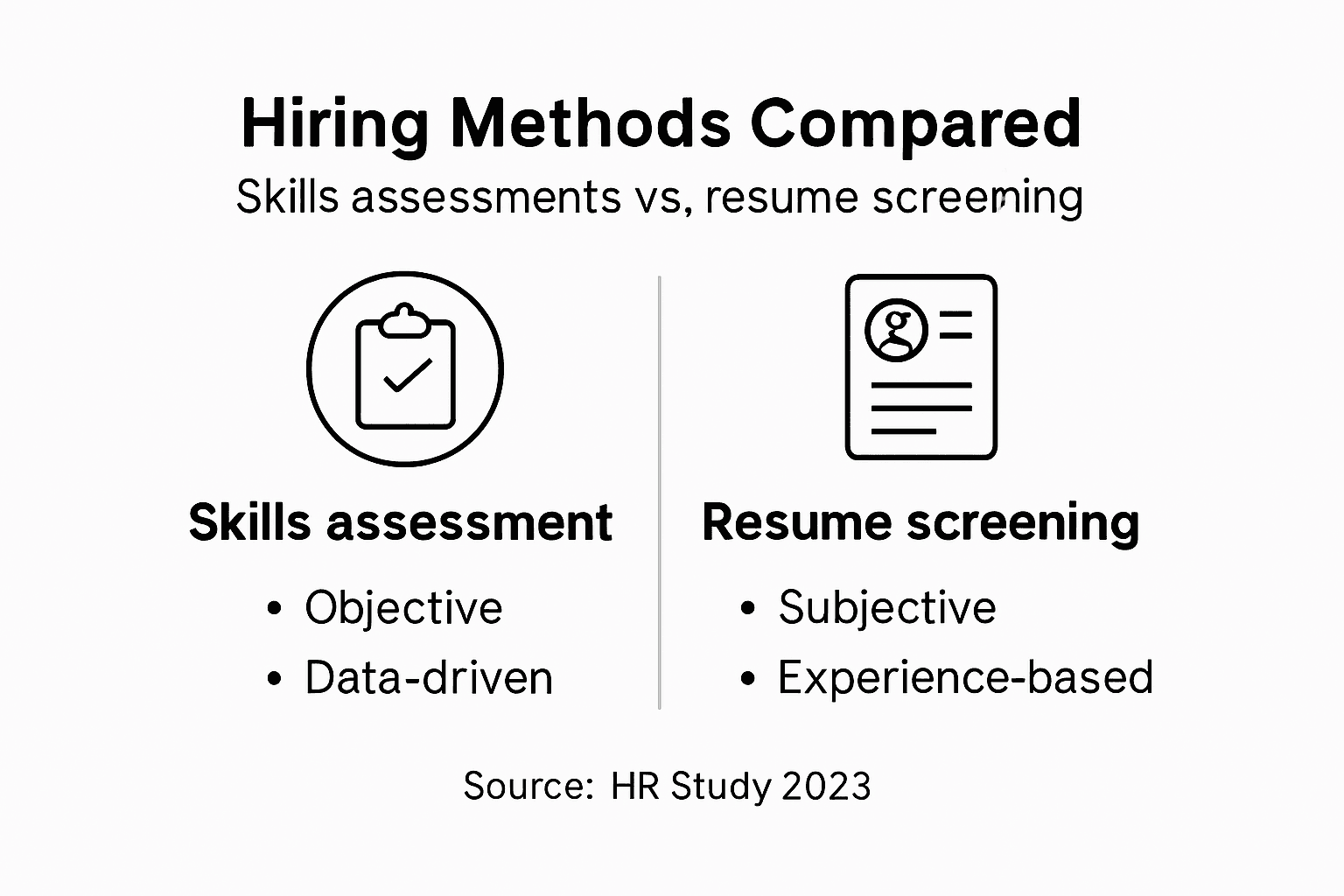
Resume screening typically relies on subjective interpretations of academic credentials and professional experiences, which frequently fail to reveal a candidate’s true capabilities. Comprehensive assessments enable recruiters to evaluate candidates through multiple dimensions, including cognitive abilities, technical skills, behavioral competencies, and cultural fit.
Moreover, skills assessments democratize the hiring process by creating opportunities for candidates who might be overlooked by traditional screening methods. Talented individuals without conventional educational backgrounds can now demonstrate their capabilities through objective, performance-based evaluations that focus on actual skills rather than predetermined credentials.
Pro tip: Design skills assessments that directly mirror the specific performance requirements of the role to maximize evaluation accuracy.
This table compares key differences between skills assessments and traditional resume screening:
| Evaluation Method | Data Reliability | Bias Reduction | Talent Discovery Approach |
|---|---|---|---|
| Skills Assessments | Objective and quantifiable | Minimizes bias | Finds hidden high-performers |
| Resume Screening | Self-reported and subjective | Susceptible to bias | Overlooks unconventional talent |
Potential Drawbacks And Mistakes To Avoid
Skills assessments, while powerful, are not infallible tools. Common implementation challenges require careful navigation to ensure fair, accurate, and meaningful candidate evaluations that truly enhance recruitment processes.
Key potential drawbacks organizations must carefully consider include:
- Risk of cultural bias in assessment design
- Potential for oversimplifying complex human capabilities
- Technological limitations in test construction
- Challenges in maintaining assessment relevance
- Potential candidate perception and resistance
Assessment design represents the most critical factor in avoiding evaluation pitfalls. Many organizations inadvertently create biased or ineffective assessments by failing to thoroughly validate testing methodologies, incorporate diverse perspectives, or align evaluations with genuine job requirements.
Poorly designed skills assessments can be more harmful than traditional screening methods, potentially introducing new forms of systemic bias.
Technological limitations can significantly compromise assessment effectiveness. Standardized tests often struggle to capture nuanced human capabilities, particularly for roles requiring complex interpersonal skills, creative thinking, or adaptive problem-solving that cannot be easily quantified through traditional measurement approaches.
Comprehensive assessment strategies must address potential cultural and contextual variations. Organizations need robust frameworks that account for diverse candidate backgrounds, learning styles, and professional experiences to prevent unintentional discrimination or misrepresentation of individual potential.
Pro tip: Regularly audit and validate your skills assessment processes with external experts to identify and mitigate potential systemic biases.
Transform Your Hiring with Real Skills Assessments
Are you tired of relying on traditional CV screening methods that miss true talent and increase hiring bias The article highlights how objective, data-driven skills assessments eliminate guesswork and reveal genuine candidate potential. If you want to challenge outdated recruitment practices and build a diverse, high-performing team WAOTM offers exactly the advanced solutions you need. Our platform integrates AI interviews, company challenges, cultural matching, cognitive tests, and video pitches that reflect real job performance requirements.
Stop making hiring decisions based on incomplete information Turn to WAOTM to replace resume screening with real assessments designed to expose true capabilities. Discover how AI-driven interviews and customized company challenges can improve predictive accuracy today. Don’t wait invite top talent to showcase their skills and culture fit now by visiting WAOTM and revolutionize your recruitment process.
Frequently Asked Questions
What are the main benefits of using skills assessments in hiring?
Skills assessments offer objective measurement of a candidate’s actual capabilities, reduce unconscious biases in hiring, and provide deeper insights into potential job performance, making hiring decisions more data-driven and accurate.
How do skills assessments differ from traditional resume screening?
Unlike traditional resume screening, which is often subjective and relies on self-reported information, skills assessments are objective and quantifiable, focusing on actual competencies and abilities demonstrated through various evaluation methods.
What types of skills assessments are commonly used in recruitment?
Commonly used types of skills assessments include cognitive aptitude tests, technical proficiency assessments, behavioral competency evaluations, performance simulations, and psychometric personality assessments, each targeting specific skill domains.
Can skills assessments help improve workplace diversity?
Yes, skills assessments can enhance workplace diversity by identifying exceptional talent that may be overlooked in traditional screenings, allowing candidates from diverse backgrounds to demonstrate their skills and potential for success, regardless of their educational credentials.