Compliant pre-employment testing for better hiring

Imagine spending three months onboarding a new hire, only to watch them walk out the door before their probation ends. It happens more often than you might think, and the cost is enormous. Getting pre-employment testing right is one of the most powerful ways to avoid that scenario, but in the Netherlands, the UK, and Spain, the rules are strict and the stakes are high. This guide walks you through the legal frameworks, the practical steps, and the smart tools that help you hire with confidence. We will cover compliance, candidate experience, and how to use assessments that genuinely predict success.
Table of Contents
- Understanding legal frameworks in pre-employment testing
- Essentials to prepare for a compliant testing process
- Step-by-step: Running the pre-employment testing process
- Avoiding pitfalls: Troubleshooting common mistakes
- Measuring and acting on results for better hires
- Why smarter pre-employment testing means balancing tech and compliance
- Transform your hiring process with We Are Over The Moon
- Frequently asked questions
Key Takeaways
| Point | Details |
|---|---|
| Legal compliance first | Always align testing methods with country-specific laws and secure explicit candidate consent. |
| Job relevance is key | Test only for job-relevant traits or risks, avoiding prohibited or intrusive inquiries. |
| Ethics and bias matters | Choose AI and other assessment tools that support unbiased and culturally fair hiring. |
| Document every stage | Keep clear records of all queries, consent, tests performed, and outcomes for transparency. |
Understanding legal frameworks in pre-employment testing
Before you run a single assessment, you need to know what the law actually permits in your country. The rules differ significantly across the Netherlands, the UK, and Spain, and getting it wrong can expose your organisation to serious legal risk.
In the Netherlands, pre-employment testing is governed primarily by the Medical Examinations Act (Wmk). Medical exams are only permitted when a role carries specific health risks, must take place at the end of the hiring process, and require explicit candidate consent. Background checks such as the VOG (Verklaring Omtrent het Gedrag) are candidate-initiated and subject to strict GDPR data limits.
In the UK, recruitment law allows cognitive and personality assessments, alongside drug testing for safety-critical roles, provided consent is documented in contracts or HR policies. The Equality Act and ACAS guidance both stress proportionality, meaning every test must be clearly justified by the requirements of the role.
In Spain, background screening is heavily shaped by GDPR and the Spanish LOPDGDD. Criminal record checks are only available for specific regulated roles and must be obtained by the candidate themselves. Health and drug tests are generally avoided unless the job explicitly requires them.
Here is a quick comparison of what is permitted across all three markets:
| Country | Cognitive tests | Medical exams | Criminal checks | Drug tests |
|---|---|---|---|---|
| Netherlands | Yes, with consent | End of process only | VOG, candidate-obtained | Rare, role-specific |
| UK | Yes, proportionate | Role-relevant only | DBS, employer-initiated | Safety roles, with consent |
| Spain | Yes, with consent | Avoided unless mandated | Candidate-obtained only | Avoided unless mandated |
Key compliance principles that apply everywhere:
- Consent must be freely given, informed, and documented
- Transparency means telling candidates what you are testing and why
- Job-relevance is non-negotiable. Every test must link directly to the role
- Data minimisation means collecting only what you genuinely need
A striking 34% of new hires leave within 90 days due to poor fit. Compliant, well-designed testing is your best defence against that statistic.
Essentials to prepare for a compliant testing process
Once you understand the legal landscape, the next step is building a solid foundation before any testing begins. Preparation is where most HR teams either get it right or create problems for themselves later.
Start with consent and data handling. Every candidate must receive a clear explanation of what tests you plan to run, why those tests are relevant to the role, and how their data will be stored and deleted. This is not just good practice. It is a legal requirement under GDPR across all three markets.

Next, define your testing criteria based on the actual job requirements. Avoid the temptation to test for everything. A focused set of assessments tied to specific competencies will always outperform a scattergun approach. Think about what skills, behaviours, and values genuinely predict success in the role.
When selecting vendors and tools, check that they are GDPR-compliant, offer bias-reduction features, and can provide documentation of their validation studies. The benefits of AI assessment are real, but only when the tools are built with fairness and transparency at their core.
Some edge cases to be aware of:
- Prohibited questions include anything related to pregnancy, HIV status, or genetic information in all three markets
- Drug testing is rare in the Netherlands and Spain, and conditional on role requirements in the UK
- VOG checks in the Netherlands filter only for convictions relevant to the specific role
- AI tools must be configured to support ethical, bias-free screening rather than replicate existing workforce patterns
Pro Tip: Build a simple testing matrix that maps each assessment to a specific job requirement. This document becomes your compliance evidence if a candidate ever challenges the process.
Step-by-step: Running the pre-employment testing process
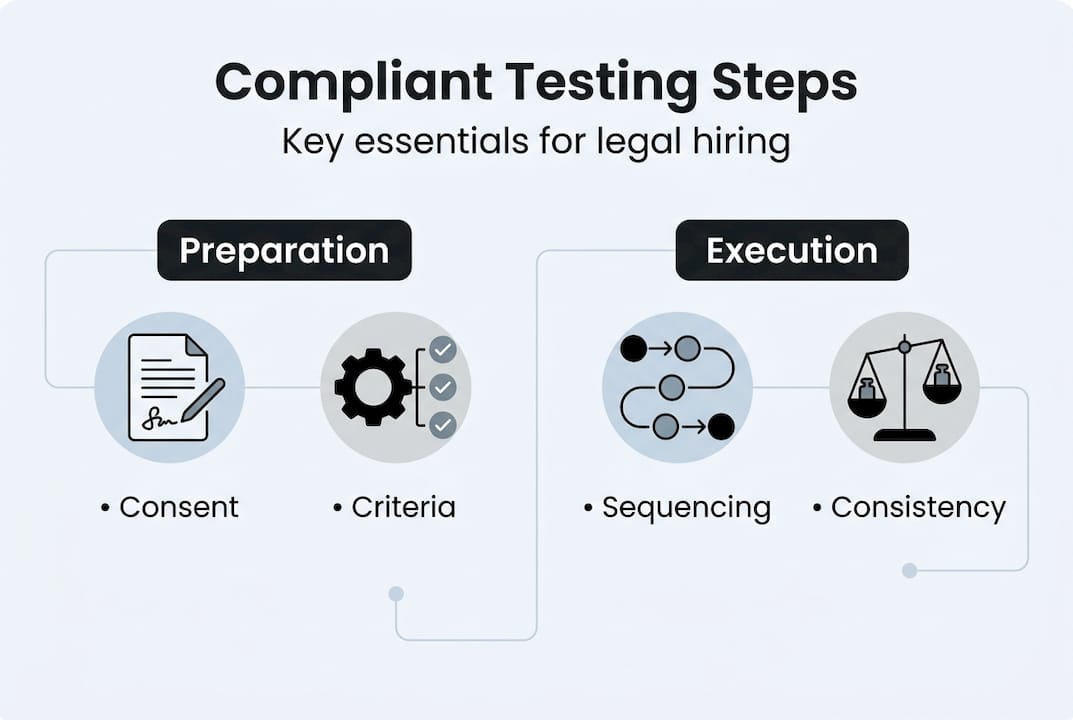
With your groundwork in place, here is how to run the process from start to finish in a way that is both compliant and genuinely useful.
- Inform candidates early. At the application stage, share a clear overview of the testing process, including what assessments are involved, when they will happen, and how results will be used.
- Run cognitive and personality assessments first. These can be completed remotely and early in the process. They help you shortlist efficiently without requiring sensitive personal data.
- Conduct structured interviews or AI-assisted screening. AI in recruitment can handle initial screening at scale, reducing time-to-hire while keeping the process consistent and fair.
- Reserve medical and background checks for late-stage candidates. In all three markets, these checks should only happen once you have a preferred candidate, and always with documented consent.
- Document every step. Keep records of consent forms, test results, and decision rationale. This audit trail protects your organisation and demonstrates good faith.
Here is how different assessment types compare in terms of timing and purpose:
| Assessment type | When to run | Primary purpose |
|---|---|---|
| Cognitive tests | Early stage | Shortlisting and role fit |
| Personality assessments | Early to mid stage | Culture and team fit |
| AI video interviews | Mid stage | Communication and values |
| Background checks | Late stage | Compliance and verification |
| Medical exams | End of process | Role-specific health requirements |
Pro Tip: Use AI interview tools to create a consistent experience for every candidate. Consistency is one of the strongest defences against discrimination claims.
The key is sequencing. Running medical checks too early, or asking for sensitive data before it is needed, is one of the most common compliance errors we see.
Avoiding pitfalls: Troubleshooting common mistakes
Even well-intentioned HR teams make mistakes with pre-employment testing. Knowing the most common ones puts you in a much stronger position.
Over-testing is a real problem. Asking candidates to complete five hours of assessments for an entry-level role damages your employer brand and is hard to justify legally. Every test must earn its place.
Lack of transparency is another frequent issue. Candidates have the right to know what they are being assessed on. Keeping the process opaque not only risks legal challenge but also puts off the best candidates, who have options.
Asking prohibited questions, even informally, can derail an otherwise compliant process. This includes questions about health, family plans, or financial history that are not directly relevant to the role.
“Strict regulatory caution and the genuine business need to reduce mis-hires are not opposites. Proportionate, consented testing is where those two priorities meet.”
Mixing data usage without consent is a serious GDPR risk. If you collect data for one purpose, such as a skills test, you cannot use it for something else, such as a personality profile, without fresh consent.
To keep your process bias-free:
- Use tools with built-in fairness audits and diverse training data
- Have a human reviewer check AI-generated recommendations before decisions are made
- Review your reasons for replacing CV screening regularly, since CVs themselves carry significant bias risk
- Track outcomes by demographic group to spot patterns early
The 34% 90-day attrition rate is a powerful reminder that poor fit costs real money. Proportionate, well-designed testing is the solution, not the problem.
Measuring and acting on results for better hires
Completing the tests is only half the job. What you do with the results determines whether your process actually improves hiring outcomes.
- Validate results against job performance data. After six and twelve months, compare assessment scores with actual performance reviews. This tells you which tests are genuinely predictive and which are just noise.
- Apply anti-bias controls at the review stage. Before making a decision, check whether any patterns in results correlate with protected characteristics. Ethical AI screening tools can flag these patterns automatically.
- Link assessments to retention metrics. If candidates who scored highly on cultural fit assessments are staying longer, that is strong evidence your process is working. Track it.
- Gather candidate feedback. Ask every candidate, whether hired or not, how they experienced the testing process. This feedback is gold for continuous improvement.
- Review and update your testing toolkit annually. Roles evolve, teams change, and the best benefits of AI interviews come from tools that are regularly recalibrated to reflect your actual hiring goals.
The goal is a feedback loop. Testing informs hiring, hiring informs performance data, and performance data improves testing. When that cycle runs well, your quality of hire goes up year on year.
Why smarter pre-employment testing means balancing tech and compliance
Here is something we genuinely believe: excessive legal caution is just as risky as non-compliance. When HR teams are so afraid of getting it wrong that they avoid meaningful assessment altogether, they end up relying on CVs and gut instinct. That is where bias and poor fit really thrive.
The future of hiring in regulated markets like the Netherlands, the UK, and Spain belongs to teams who treat compliance as a foundation, not a ceiling. Legal frameworks tell you what you cannot do. They do not tell you to do as little as possible.
AI and skills-based assessments, when implemented ethically, give you a genuine picture of who a candidate is and how they will perform. They reduce the noise that comes from polished CVs and interview nerves. They create a fairer process for candidates who do not fit the traditional mould.
We think AI in recruitment in 2026 is genuinely exciting, and the HR professionals who will get the most from it are those who combine legal rigour with a real appetite for innovation. That combination is rare. It is also exactly what the best candidates deserve.
Transform your hiring process with We Are Over The Moon
If this guide has got you thinking about how to raise the bar on your pre-employment testing, we would love to show you what is possible.
We Are Over The Moon is built for HR teams who want to go beyond the CV. Our platform combines AI interviews, cognitive assessments, cultural matching, and video pitches into a single GDPR-first workflow. You can match on skills and values from the very first touchpoint, with full auditability at every stage. Whether you are hiring in Amsterdam, London, or Madrid, our AI candidate validation platform helps you find the right people faster and with far greater confidence. Come and see what genuinely better hiring looks like.
Frequently asked questions
What types of pre-employment testing are legal in the Netherlands?
In the Netherlands, you may carry out job-relevant medical exams at the end of the process with candidate consent, and use VOG criminal background checks where the role specifically requires them.
Can I require drug testing during hiring in the UK?
Drug testing is permitted only for safety-critical roles with documented consent, and must be clearly justified in your contracts or HR policies to avoid breaching equality law.
What are the most common mistakes with pre-employment testing?
The most frequent errors include seeking prohibited personal information such as pregnancy or health status, testing for traits unrelated to the role, and using candidate data for purposes beyond what was originally consented to.
How can I keep pre-employment tests bias-free?
Use AI-driven screening tools designed for fairness, validate all test content for cultural neutrality, and review outcome patterns regularly to catch any emerging bias before it affects your hiring decisions.