Why diversity matters in hiring: a guide for HR leaders

TL;DR:
- Diversity in hiring produces measurable economic benefits and enhances team innovation and performance.
- Effective inclusion practices are essential to realize the full potential of diverse teams and drive business success.
Diversity in hiring is one of those topics everyone agrees matters, yet far too few organisations treat it as the genuine performance driver it is. Research now shows that racial diversity in education cohorts increases graduate starting salaries by up to $30,000 per cohort, which tells us something powerful: diversity does not just serve social goals. It produces measurable economic outcomes for everyone involved. As an HR leader in Spain, the UK, or the Netherlands, you are in a position to build that kind of impact directly into your hiring process. This guide shows you exactly how.
Table of Contents
- Understanding the business case for diversity in hiring
- How perceptions of diversity influence talent attraction and employer branding
- The critical role of inclusion in realising diversity’s benefits
- Legal requirements and best practices for diversity hiring in Spain, the UK, and the Netherlands
- Innovative strategies for inclusive hiring that enhance diversity
- Rethinking diversity: what most HR leaders overlook
- How We Are Over The Moon supports your diversity hiring goals
- Frequently asked questions
Understanding the business case for diversity in hiring
Many HR leaders already believe in diversity. The challenge is convincing boards, hiring managers, and budget holders who want hard evidence. The good news is that the evidence is there, and it is compelling.
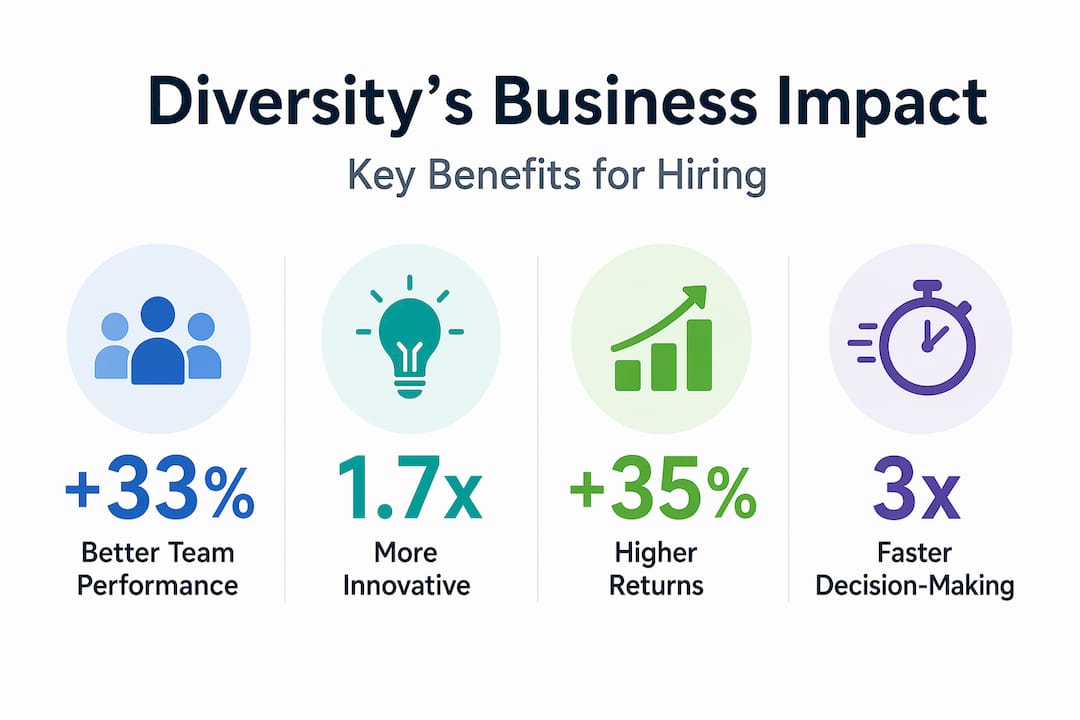
Diverse teams consistently outperform homogeneous ones on problem-solving, creativity, and decision-making. When people with different life experiences and perspectives sit in the same room, they challenge assumptions that would otherwise go unquestioned. That friction, handled well, is where innovation lives.
Here is what the research tells us about the benefits of diverse hiring:
- Better financial outcomes. Companies with above-average diversity produce a greater proportion of revenue from innovation than their less diverse peers.
- Improved talent pipelines. Candidates actively seek employers who reflect their values, and diversity signals a culture of respect.
- Higher graduate earnings. Racial diversity in cohorts boosts starting salaries not just for minority graduates but for everyone in that cohort, demonstrating that diverse learning and working environments lift all boats.
- Stronger retention. Employees in diverse workplaces report higher engagement and lower intentions to leave.
“The salary premium associated with diversity is not a minority benefit. It is a collective one. Everyone in a more diverse cohort earns more.”
If you are looking to build a thorough business case for your stakeholders, our diversity hiring guide is a great place to start with the numbers and frameworks you need.
The business case is not just about being fair. It is about being effective. Once HR leaders frame diversity this way, the conversation with leadership changes completely.
How perceptions of diversity influence talent attraction and employer branding
Talent attraction is increasingly driven by values alignment. Candidates, particularly those entering the workforce in the last five years, research a company’s culture before they apply. Diversity in the workplace is one of the first signals they look for.
Most Americans view racial and ethnic diversity as important for companies, though views vary by political affiliation and ethnicity. While this data reflects the US context, similar dynamics play out across Europe. In the Netherlands, Spain, and the UK, attitudes toward workplace diversity are shaped by generational shifts, immigration patterns, and national policy debates. HR leaders operating across these markets need to be aware that a single diversity message does not land the same way everywhere.
What this means for your employer brand:
- Visible diversity in company communications, leadership teams, and job adverts signals genuine commitment rather than lip service.
- Candidates from underrepresented groups pay close attention to whether diversity is performative or embedded in the culture.
- Transparent reporting on diversity metrics builds credibility with both candidates and existing employees.
- Competitors who communicate diversity well are winning talent you could be hiring.
To attract diverse candidates successfully, consider the following steps:
- Audit your current job descriptions for exclusionary language and unnecessary requirements.
- Diversify your sourcing channels beyond traditional job boards to reach underrepresented communities.
- Train hiring managers on the link between inclusive language and candidate response rates.
- Showcase employee stories that reflect genuine diversity across levels, not just entry roles.
Handling hiring challenges and cultural fit well is central to this. Employer branding is not a marketing exercise. It is a hiring strategy, and diversity is one of its most powerful components.
The critical role of inclusion in realising diversity’s benefits
Here is something that does not get said enough: diversity without inclusion is not just ineffective. It is actively harmful. You can hire a diverse workforce and still create an environment where people feel unseen, undervalued, or unable to speak up. That is tokenism, and it drives talented people out the door.

Diversity benefits materialise only when combined with inclusive practices that make employees feel respected and able to contribute. Inclusion is the mechanism that converts the potential of a diverse team into actual performance.
What does genuinely inclusive hiring look like in practice?
- Structured interviews that assess all candidates against the same criteria, reducing the influence of unconscious bias.
- Diverse shortlisting that ensures underrepresented candidates are consistently present at every stage of the process.
- Onboarding programmes that explicitly welcome different backgrounds and set expectations for respectful collaboration.
- Psychological safety built into team culture, so diverse voices are not just present but genuinely heard.
Pro Tip: Build a quarterly feedback loop with employees from underrepresented groups. Ask specific questions about whether they feel able to contribute ideas and whether they see themselves represented in leadership. Use that data to adjust your inclusion strategy, not just your diversity numbers.
Our fair recruitment guide covers the practical steps in detail, including how to audit your current processes for hidden bias.
Inclusion is not a bolt-on to diversity. It is the whole point.
Legal requirements and best practices for diversity hiring in Spain, the UK, and the Netherlands
Understanding why inclusive hiring matters is one thing. Knowing your legal obligations is another. For HR leaders across these three markets, the regulatory landscape is distinct but shares a common thread: equality is not optional.
Spanish companies with 50 or more employees must implement a legally binding equality plan with specific gender equality measures. These plans must be registered and updated regularly, covering areas including recruitment, pay, training, and promotion. Failing to comply carries real legal and reputational risk.
In the UK, workforce diversity benchmarks from CIPD provide sector-by-sector ethnicity data, giving HR teams a reference point for measuring their own representation against industry norms. The UK’s Equality Act 2010 sets the legal baseline, but leading employers go well beyond it.
In the Netherlands, the Working Conditions Act and the Equal Treatment Act create a framework for non-discrimination, and there is growing pressure on large employers to report diversity metrics publicly.
| Country | Key legal requirement | Recommended best practice |
|---|---|---|
| Spain | Equality plan for 50+ employees | Annual review and registered updates |
| United Kingdom | Equality Act compliance | Ethnicity pay gap reporting and CIPD benchmarking |
| Netherlands | Equal Treatment Act | Voluntary diversity reporting and bias audits |
Best practices across all three markets include:
- Embedding diversity goals into your employer value proposition, not just your compliance documents.
- Training all hiring managers on both legal requirements and inclusive interviewing techniques.
- Using data to track representation at every stage of the hiring funnel, not just at offer stage.
Understanding why cultural alignment matters is equally important here. Legal compliance sets the floor. Building a genuinely inclusive culture raises the ceiling.
Innovative strategies for inclusive hiring that enhance diversity
Knowing the rules and understanding the benefits only takes you so far. The real question is: what does modern, effective diversity hiring actually look like in practice? Here are the approaches we see working right now.
Ethnic diversity at work fosters interethnic contact and shared resources, which promote tolerance and cooperation across the whole team. That is not just a feel-good outcome. It is a measurable improvement in team cohesion and productivity.
- Replace CV screening with skills-based assessments. CVs reflect privilege as much as ability. Challenge-based hiring tasks and work samples reveal what candidates can actually do, regardless of where they studied or who they know.
- Use AI tools to reduce unconscious bias. AI bias reduction in recruitment helps remove name, gender, and age signals from early screening, allowing merit to drive decisions.
- Assess cultural intelligence, not just cultural fit. Cultural fit can easily become a code for “similar to us.” Cultural intelligence in hiring measures a candidate’s ability to work across difference, which is far more valuable in diverse teams.
- Introduce video pitches and personality assessments. These tools give candidates who are less polished on paper an equal chance to show their thinking and communication style.
- Use structured scoring panels across multiple interviewers. When decisions are made collaboratively, individual bias has less room to operate.
Pro Tip: Diverse interview panels are one of the simplest and most effective tools available. When candidates see interviewers who look like them, they perform better and feel more confident. And when panel members have different backgrounds, they catch different things.
The impact of diversity on performance is not accidental. It is the product of deliberate, well-designed hiring systems.
Rethinking diversity: what most HR leaders overlook
Here is the uncomfortable truth that most diversity conversations dance around: treating diversity as a values exercise rather than a business priority is why so many DEI programmes underdeliver. When diversity sits in HR as a compliance function, separate from talent strategy and business outcomes, it never gets the investment or the urgency it deserves.
We see this play out repeatedly. A company launches a diversity initiative, hires a few people from underrepresented groups, celebrates the numbers, and then wonders why retention is poor and innovation has not improved. The answer is almost always the same: they focused on representation without addressing the systems that shape the day-to-day experience of those employees.
Ending affirmative action and DEI initiatives risks making everyone poorer, not just underrepresented groups. That is not a political argument. It is an economic one, backed by salary data from real graduates in real labour markets.
The HR leaders who are winning on diversity right now share one trait: they have connected it directly to diversity hiring insights about business performance, not just social responsibility. They track diversity through the hiring funnel the same way they track conversion rates. They tie inclusion metrics to engagement scores. They report to the board on diverse workforce advantages alongside revenue and retention.
Diversity is not a box to tick. It is a hiring discipline. And the organisations that treat it that way are building teams that genuinely outperform.
How We Are Over The Moon supports your diversity hiring goals
We are genuinely excited about what is possible when HR leaders have the right tools. Understanding why diversity matters in hiring is the first step. Acting on it with an assessment-led approach is where the transformation happens.
At We Are Over The Moon, we have built a platform that replaces CV screening with real assessments: AI interviews, company challenges, cultural matching, cognitive tests, and video pitches. Everything is designed to surface talent based on what people can do, not what their CV looks like. Our skills-based matching approach removes the structural barriers that keep diverse candidates out of your shortlists. Whether you are meeting Spain’s equality plan requirements, benchmarking against UK ethnicity data, or building a more inclusive culture in the Netherlands, our AI candidate validation platform gives you the tools to do it with confidence and consistency.
Frequently asked questions
Why is diversity important in hiring?
Diversity in hiring brings varied perspectives that improve problem-solving, innovation, and performance, and policies promoting racial diversity show measurable economic benefits for entire cohorts, not just individuals from underrepresented backgrounds.
How does inclusion relate to diversity in the workplace?
Inclusion ensures that diverse employees feel respected and able to contribute, and without inclusive practices the potential benefits of a diverse workforce simply do not materialise in practice.
What legal requirements exist for diversity hiring in Spain?
Spanish companies with 50 or more employees must adopt and register a legally binding equality plan covering hiring, pay, and promotion, with specific gender equality measures built in.
Can technology help reduce bias in recruitment?
Yes. AI reduces bias in recruitment by shifting focus to skills and cultural intelligence rather than CV markers that often reflect privilege rather than capability.