Why measure soft skills: boost hiring success by 5x

TL;DR:
- Most mis-hires are due to soft skill mismatches, not technical ability.
- Objective soft skills assessment improves hiring success, diversity, and team resilience.
- Hybrid AI and structured evaluations are key to reliable, bias-reduced soft skills measurement.
Most mis-hires have nothing to do with technical ability. The candidate knew the tools, passed the tests, and looked great on paper. Yet within months, they were struggling with teamwork, communication, or managing pressure. Soft skills predict performance and retention better than hard skills alone, and yet most hiring processes still treat them as an afterthought. For HR professionals and talent acquisition specialists across the Netherlands, UK, and Spain, this is changing fast. This article explains what soft skills measurement actually involves, why the business case is compelling, and how you can put the right methods to work in your organisation today.
Table of Contents
- Why soft skills matter more than ever
- The business case: measuring soft skills for better hiring outcomes
- How to measure soft skills: methods and tools explained
- EMEA perspective: regional adoption, benchmarks, and what actually works
- Why most soft skills measurement fails—and how to fix it
- Next steps: transform your hiring with evidence-based soft skills measurement
- Frequently asked questions
Key Takeaways
| Point | Details |
|---|---|
| Soft skills predict success | Assessing soft skills leads to better hiring, less turnover, and improved team performance. |
| Objectivity reduces bias | Using structured and AI-supported tools cuts unconscious bias and opens talent pools. |
| Hybrid methods work best | Combining human judgement and AI produces the most reliable measurement results. |
| Adoption is rising fast | The Netherlands, UK, and Spain are quickly shifting toward measurable soft skills in hiring. |
Why soft skills matter more than ever
Soft skills are the interpersonal, behavioural, and cognitive traits that shape how someone works with others, adapts to change, and handles pressure. Think communication, empathy, resilience, and problem-solving. They sit alongside hard skills (technical knowledge and qualifications) but are far harder to spot on a CV.
Here is the thing: hard skills get someone through the door, but soft skills determine whether they thrive. The evidence is striking. 72% of dismissals are due to behavioural or soft skill issues, not technical gaps. Research consistently shows that soft skills account for roughly 85% of job success, and 89% of bad hires trace back to poor soft skill fit rather than missing qualifications.
“Hiring for technical skills alone is like building a house on sand. Soft skills are the foundation that holds everything together.”
The most critical soft skills for today’s roles include:
- Communication: The ability to convey ideas clearly and listen actively
- Adaptability: Staying effective when priorities shift or challenges arise
- Collaboration: Working productively within diverse teams
- Emotional intelligence: Recognising and managing emotions in yourself and others
- Critical thinking: Analysing situations and making sound decisions under pressure
Across the Netherlands, UK, and Spain, HR leaders are waking up to this reality. Organisations that rely purely on credentials and interviews are finding themselves stuck in expensive hiring cycles. Those who invest in soft skills assessment benefits are reporting stronger retention, better team cohesion, and more confident hiring decisions. The shift is not just cultural. It is driven by hard commercial logic, and we are genuinely excited to see it accelerating.
The business case: measuring soft skills for better hiring outcomes
Let us talk numbers, because the data here is genuinely impressive. Competency-based hiring predicts job success five times better than CVs or diplomas alone, and delivers a 60% higher candidate success rate. That is not a marginal improvement. That is a fundamental shift in hiring quality.

60% higher candidate success rate when competency-based hiring replaces traditional CV screening.
Measuring soft skills also opens the door to skills-based hiring, which accesses wider talent pools, improves diversity, and reduces unconscious bias in recruitment. When you stop filtering by degree or job title and start filtering by demonstrated behaviour, you naturally reach candidates who would otherwise be overlooked.
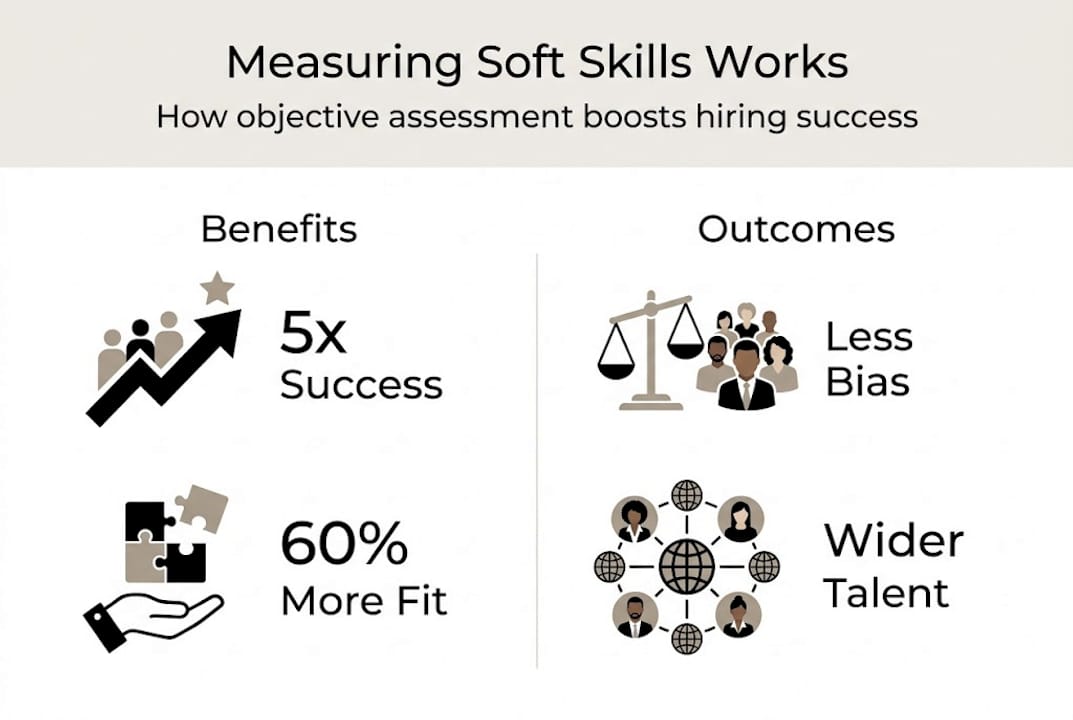
Here is a quick comparison of hiring outcomes:
| Metric | Traditional CV-based hiring | Soft skills measurement |
|—|—|—|
| Candidate success rate | ~40% | ~64% |
| Time to identify top performers | Months | Weeks |
| Bias risk | High | Significantly reduced |
| Diversity of shortlists | Limited | Broader and more varied |
The business advantages stack up quickly:
- Reduced bias: Structured assessments remove the subjectivity of gut-feel interviews
- Greater inclusion: Skills-based criteria open roles to non-traditional candidates
- Lower turnover: Better soft skill fit means people stay longer and perform better
- Stronger teams: Hiring for collaboration and adaptability builds more resilient teams
- Faster decisions: Objective data speeds up shortlisting and reduces back-and-forth
Exploring AI assessment benefits and understanding how candidate assessment tools improve hiring efficiency are excellent starting points if you want to see these gains in practice. The organisations leading on this are not just hiring better. They are building a genuine competitive advantage.
How to measure soft skills: methods and tools explained
Not all soft skills measurement is created equal. Some methods are far more reliable than others, and choosing the wrong approach can actually introduce more bias, not less.
| Method | Accuracy | Bias risk | Best use |
|---|---|---|---|
| Unstructured interview | Low | High | Initial screening only |
| Structured behavioural interview | Moderate | Medium | Mid-process |
| Situational judgement test (SJT) | Good (validity 0.32) | Low | Role-specific scenarios |
| Psychometric assessment | Good | Low | Personality and cognitive fit |
| AI-powered video assessment | High (correlation 0.38) | Very low | Scalable, consistent scoring |
AI and SJTs double assessment accuracy and reduce subjectivity compared to traditional methods. To put that in context, AI achieves a predictive correlation of 0.38 versus 0.16 to 0.21 for traditional interviews. That is a meaningful leap in reliability.
The most effective approach combines methods rather than relying on any single tool:
- Start with an AI video pitch or structured assessment to gather consistent, comparable data on all candidates
- Layer in an SJT to test how candidates respond to realistic work scenarios relevant to your role
- Use psychometrics to understand personality traits and cultural alignment
- Finish with a structured human interview to validate findings and explore nuance
Pro Tip: Avoid relying on 360-degree feedback or manager ratings alone during hiring. These are valuable for development but too subjective for selection decisions. Pair them with validated tools for reliable results.
Seeing examples of AI interviews in action can help you understand how these tools work in practice. And if you are new to the space, defining AI interviews in HR is a great place to begin building your knowledge.
EMEA perspective: regional adoption, benchmarks, and what actually works
Across Europe, the momentum behind soft skills measurement is building rapidly. In the Netherlands, 43% of organisations have already shifted to competency-based hiring, while Spain’s HR assessment market is growing quickly with a strong focus on behavioural and soft skills evaluation. In the UK, major employers including PwC and EY have publicly committed to removing degree requirements and hiring on demonstrated skills and behaviours instead.
What separates the leaders from the laggards? A few things stand out. Leading organisations are investing in structured, technology-assisted assessment at scale. They are mapping soft skills directly to job requirements rather than using generic rubrics. And they are monitoring outcomes continuously to spot and correct any adverse impact on particular groups.
“Hybrid AI and human assessment is fast becoming the standard for organisations serious about objective, fair, and effective hiring.”
360 reviews alone are insufficient for objective measurement, and organisations that rely on them for selection decisions are leaving themselves exposed to inconsistency and bias. The hybrid approach, combining AI candidate screening with structured human evaluation, is where the real gains are being made.
Compliance is also a driver. GDPR requirements across the EU mean that assessment processes need to be transparent, auditable, and free from discriminatory criteria. Well-designed soft skills tools actually help organisations meet these standards, because they produce documented, consistent evidence for every hiring decision.
Pro Tip: If you are just getting started, focus first on your highest-turnover roles. These are where mis-hires cost the most, and where AI reducing recruitment bias will deliver the fastest, most visible return on investment.
Why most soft skills measurement fails—and how to fix it
Here is something we see repeatedly: organisations invest in soft skills assessment, then wonder why it does not move the needle. The reason is almost always the same. The assessment is disconnected from the actual job. Generic competency frameworks, vague interview questions, and inconsistent scoring mean the data collected tells you very little about how someone will actually perform.
Relying on manager gut feeling dressed up as a structured process is not objectivity. It is bias with extra steps. True measurement requires a clear skills map tied to specific role outcomes, consistent scoring criteria applied by every assessor, and a mix of validated tools rather than a single method.
The other common mistake is treating soft skills assessment as a one-off event. The best organisations treat it as an iterative process, calibrating their tools regularly and monitoring for adverse impact across demographic groups. Replacing CVs with AI assessments is a powerful starting point, but the real wins come from building a continuous improvement mindset into your hiring process. Start small, measure everything, and iterate.
Next steps: transform your hiring with evidence-based soft skills measurement
If you are ready to move beyond gut feeling and CV screening, the tools and evidence are firmly on your side. Evidence-based soft skills measurement delivers better hires, stronger teams, and a fairer process for every candidate.
At We Are Over The Moon, we are genuinely over the moon about what is possible when you replace traditional screening with real assessments. Our skills-based hiring platform brings together AI interviews, company challenges, cultural matching, cognitive tests, and video pitches in one place. Explore about We Are Over The Moon to learn more about our approach, or visit our AI candidate validation tools to see how we can help you hire with confidence. Let us build something better together.
Frequently asked questions
What are soft skills and why are they crucial for hiring?
Soft skills are interpersonal traits like communication, adaptability, and emotional intelligence that predict job performance and reduce mis-hires far more reliably than technical qualifications alone.
How can soft skills be measured objectively?
You can measure soft skills accurately using structured interviews, situational judgement tests, AI video analysis, and validated psychometric tools. AI and SJTs increase accuracy and significantly reduce subjectivity compared to traditional methods.
What is the impact of measuring soft skills on diversity and bias?
Objective measurement enables skills-based hiring, which opens wider talent pools and reduces unconscious bias by focusing on demonstrated behaviour rather than credentials or background.
Why are traditional interviews or 360-feedback not enough?
Traditional interviews and 360 reviews are insufficient for objective selection because they are highly susceptible to personal bias. Hybrid AI and structured assessment tools are needed for consistent, reliable results.
Which countries in Europe are leading in soft skills measurement?
The Netherlands, UK, and Spain are all advancing rapidly. 43% of Dutch organisations have adopted competency-based hiring, Spain’s HR assessment market is growing strongly, and UK employers like PwC and EY are leading the shift to skills-based selection.