Pre-employment tests: smarter hiring in 2026

TL;DR:
- Pre-employment tests provide objective data that improve hiring accuracy and predict job performance.
- Combining multiple validated assessment types enhances predictive validity and reduces bias risks.
- Legal compliance requires job relevance, candidate consent, and regular fairness monitoring across European markets.
Traditional hiring is broken in ways most talent teams don’t realise. Unstructured interviews predict performance at a validity rate of just 0.18 to 0.38, yet they remain the default in countless organisations across the Netherlands, UK, and Spain. Pre-employment tests change that entirely. They give you objective, data-driven insight into how a candidate will actually perform, not just how well they interview. In this guide, we cover what these tests measure, why the evidence behind them is so compelling, and how to implement them in a way that is both legally sound and genuinely fair.
Table of Contents
- What are pre-employment tests and why do they matter?
- How effective are pre-employment tests? The evidence
- Compliance and candidate fairness: Legal considerations in NL, UK, and Spain
- Best practices: How to implement pre-employment tests for optimal impact
- Why the true value of pre-employment tests is often misunderstood
- Power your hiring with smarter, compliant pre-employment testing
- Frequently asked questions
Key Takeaways
| Point | Details |
|---|---|
| Tests boost hiring accuracy | Validated pre-employment tests predict job performance better than resumes or interviews alone. |
| Legal compliance is essential | Following GDPR and equality laws ensures tests are fair, transparent, and avoid legal risk. |
| Multi-method approach works best | Combining cognitive, personality, and skills tests yields the most reliable hiring results. |
| Integration streamlines hiring | Linking tests with ATS automates volume screening and improves efficiency for HR teams. |
What are pre-employment tests and why do they matter?
Pre-employment tests are structured assessments completed by candidates before a hiring decision is made. Their purpose is simple: give you reliable, comparable data on each applicant so you can move beyond gut feeling and CV scanning. They sit alongside interviews and references, but they do something those tools rarely achieve on their own. They measure actual capability.
There are several main types worth knowing:
- Cognitive ability tests assess reasoning, problem-solving, and learning speed. They are among the strongest predictors of job performance across roles.
- Personality assessments explore traits like conscientiousness, openness, and emotional stability. Useful for cultural fit and team dynamics.
- Skills tests measure job-specific competencies, from coding to copywriting to customer service scenarios.
- Integrity tests evaluate honesty, reliability, and ethical judgement, particularly valuable in roles with access to sensitive data or finances.
- Situational judgement tests present realistic work scenarios and ask candidates to choose the best course of action.
Together, these tools form a much richer picture than a CV ever could. A CV tells you where someone has been. A validated test tells you what they can do.
“Pre-employment tests provide objective data to predict job performance, reduce turnover, and improve hiring accuracy far beyond what traditional screening alone can achieve.”
This is why forward-thinking HR teams are turning to innovative assessment methods that go well beyond the standard CV review. When you screen without CVs, you open the door to talent that might otherwise be filtered out unfairly. Many organisations are also pairing these tests with assessment centres for senior or specialist roles, creating a layered approach that is both robust and defensible.
The shift matters enormously. When your assessment process is grounded in validated data, you hire with confidence rather than hope.
How effective are pre-employment tests? The evidence
Now that you know the basics of these tests, let’s look at the evidence that sets them apart.
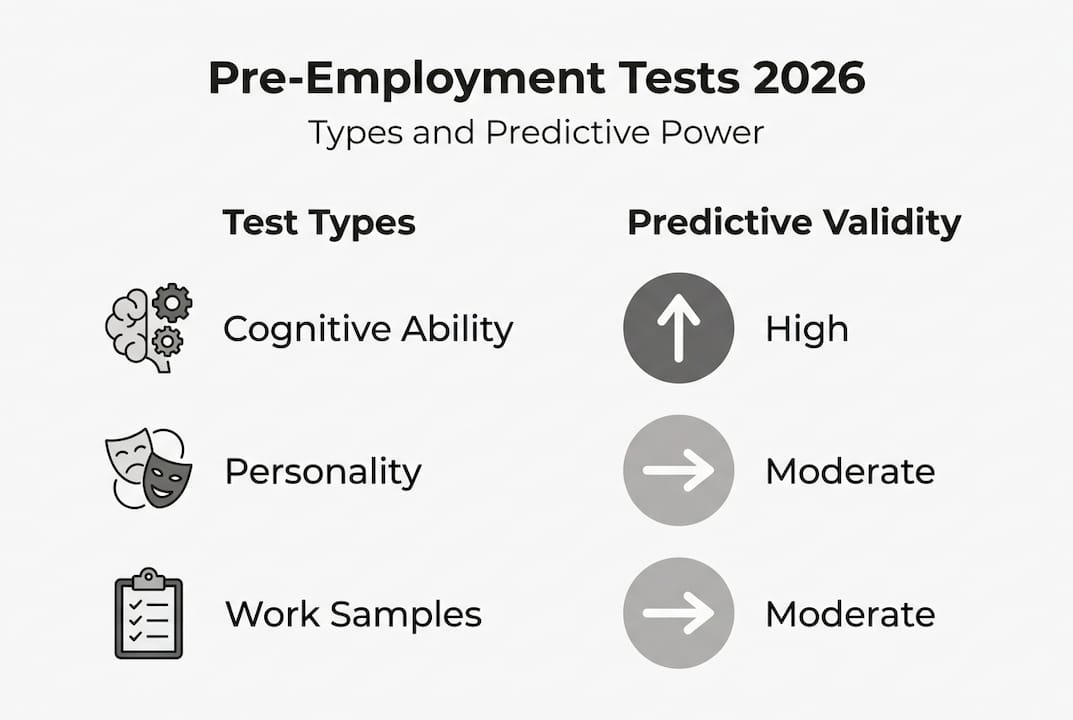
The numbers are genuinely exciting. Cognitive ability tests reach a validity correlation of approximately 0.51, and when you combine them with other validated methods, predictive validity climbs to between 0.65 and 0.70. Compare that to unstructured interviews, which sit between 0.18 and 0.38, and the difference is stark.

| Assessment method | Predictive validity range |
|---|---|
| Unstructured interview | 0.18 to 0.38 |
| Structured interview | 0.44 to 0.51 |
| Cognitive ability test | ~0.51 |
| Work sample test | ~0.54 |
| Multi-method approach | 0.65 to 0.70 |
These figures matter because predictive validity directly translates to better hires, lower turnover, and reduced cost-per-hire. Organisations that use validated assessments consistently report improvements in first-year retention and role performance ratings.
Spain is a particularly interesting market right now. The Spain HR assessment services market is growing rapidly, driven by demand for structured, evidence-based hiring in both large enterprises and scale-ups. Spanish talent teams are increasingly looking for tools that satisfy both performance goals and strict data regulations.
For HR leaders managing volume hiring or cross-border talent pipelines, the efficiency gains from using assessment tools are just as significant as the quality improvements. Fewer wasted interviews. Faster shortlisting. Clearer comparisons.
Pro Tip: Don’t rely on a single test type. Combining cognitive ability tests with personality assessments and a skills-based task consistently delivers the strongest predictive outcomes. Think of it as triangulation: each tool confirms or challenges what the others reveal.
The evidence is clear. Pre-employment tests aren’t a nice-to-have. For teams serious about hiring quality, they are a genuine competitive advantage.
Compliance and candidate fairness: Legal considerations in NL, UK, and Spain
High effectiveness means little without fairness and legal compliance, especially across diverse European markets.
All three markets share a common foundation: tests must be job-relevant, validated, and administered with proper candidate consent. But the specifics vary, and getting them wrong carries real risk.
Here are the core compliance essentials every HR team should follow:
- Validation: Only use tests that have been validated for the specific role and context. Generic tests applied broadly can create adverse impact.
- GDPR consent: Candidates must be clearly informed about what data is collected, how it is used, and how long it is retained. This applies in all three markets.
- Proportionality: The assessment burden should match the role. A lengthy battery of tests for an entry-level position may be disproportionate and put off good candidates.
- Disability adjustments: Reasonable adjustments must be offered to candidates with disabilities. This is a legal requirement in the UK and Netherlands.
- Adverse impact monitoring: Regularly review results by demographic group to identify any unintended bias in your assessments.
- AI transparency: If AI is involved in scoring or shortlisting, candidates in the EU have the right to a human review of automated decisions.
The UK CIPD emphasises validated assessments and compliance with equality laws, while Spain’s framework demands consent and proportionality under GDPR. For detailed employment law guidance, the CIPD resource centre is a solid starting point for UK-based teams.
When it comes to candidate experience, research consistently shows that well-communicated, relevant tests are received positively. Candidates appreciate transparency about why they are being assessed and what the results mean. Problems arise when tests feel arbitrary or excessively long.
For teams looking to build a process that is both rigorous and respectful, exploring compliance in testing is a smart first step. Pairing that with the right assessment tools for compliance makes the whole process far more manageable.
Pro Tip: Focus on validated, job-relevant tests and document your rationale for every assessment you include. This protects you legally and signals to candidates that your process is thoughtful and fair.
Best practices: How to implement pre-employment tests for optimal impact
To unlock these benefits and navigate legalities, a rigorous approach is crucial. Here’s how to get it right.
- Conduct a job analysis. Before selecting any test, identify the key competencies, skills, and behaviours required for success in the role. This is your foundation.
- Select validated tests. Choose assessments that have published validity data for your role type and industry. Avoid off-the-shelf tools with no supporting research.
- Review for GDPR compliance. Confirm that your test provider processes data in line with EU regulations, including data retention policies and candidate rights.
- Integrate with your ATS. Multi-method approaches integrated with ATS systems increase predictive accuracy and reduce manual admin significantly.
- Communicate clearly with candidates. Tell applicants what to expect, how long the assessment takes, and how results will be used. Transparency builds trust.
- Pilot before scaling. Run the assessment with a small cohort first. Check for adverse impact, candidate feedback, and alignment with eventual hire quality.
| Approach | Standalone tests | Integrated approach |
|---|---|---|
| Predictive accuracy | Moderate | High |
| Admin burden | High | Low |
| Candidate experience | Variable | Consistent |
| Compliance tracking | Manual | Automated |
| Scalability | Limited | Strong |
For teams managing high volumes, pre-screening automation can save over 23 hours per hire by streamlining assessment delivery and results analysis. Pairing that with a clear screening workflow ensures nothing falls through the cracks.
Pro Tip: Set a regular review cycle, at least every six months, to check your assessment results for demographic bias. Hiring patterns shift, and so do your candidate pools. Staying proactive keeps your process fair and legally defensible.
Why the true value of pre-employment tests is often misunderstood
Stepping back, it is vital to see why the real value of these tests goes beyond numbers and efficiency claims.
We see this regularly: organisations adopt pre-employment tests expecting them to do all the heavy lifting, then feel disappointed when hiring quality doesn’t transform overnight. The issue isn’t the tests. It’s the expectation that they replace human judgement rather than sharpen it.
Tests are brilliant at surfacing data. They are not brilliant at reading context, understanding career motivation, or sensing cultural nuance. The best hiring decisions we’ve seen come from teams who treat test results as one strong input among several, not as the final word.
There is also a real risk of over-testing. Overuse or misuse of tests can harm candidate experience and damage your employer brand, particularly if candidates feel assessed rather than welcomed. The most reliable gains come from measured, inclusive, and validated strategies that respect the candidate’s time and dignity.
We are over the moon about what unbiased screening can achieve when done well. And pairing that with AI for cultural fit assessment adds a layer of insight that purely cognitive tools simply can’t match. The goal is a process that is fair, fast, and genuinely predictive.
Power your hiring with smarter, compliant pre-employment testing
If you are ready to move beyond CVs and gut feeling, we are here for it. At WAOTM, we combine AI interviews, cognitive tests, cultural matching, video pitches, and company challenges into one seamless platform built for HR teams in the Netherlands, UK, and Spain.
Our approach is grounded in validated science and designed to meet GDPR requirements across all three markets. Whether you are scaling volume hiring or refining how you assess senior talent, you can match on skills rather than credentials. Explore our AI validation platform and see how smarter assessment transforms your next hiring round.
Frequently asked questions
Which types of pre-employment test are most effective for predicting job performance?
Cognitive ability tests, integrity assessments, and work sample tests have the highest predictive validity for job performance when properly validated and combined into a multi-method approach.
How do legal requirements differ for pre-employment testing across the Netherlands, UK, and Spain?
All three countries require tests to be job-related and validated. Spain’s GDPR and UK equality law set the key frameworks, with Spain applying particularly strict consent and proportionality rules.
Do pre-employment tests cause legal or reputational risks if used incorrectly?
Yes. Unvalidated or poorly designed tests can lead to discrimination claims and damage your employer brand, especially if adverse impact across demographic groups is not monitored regularly.
Can pre-employment testing improve both candidate experience and operational efficiency?
Absolutely. When tests are thoughtfully designed and communicated, they boost hiring speed and quality while being positively received by candidates who appreciate a fair and transparent process.